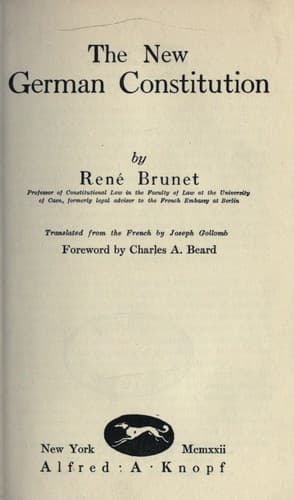
Germany -- Politics and government -- 1918-1933; Germany. Verfassung (1919)
Expropriation may be proceeded with only for the benefit of the community
and by due process of law. There shall be just compensation in so far
as is not otherwise provided by national law. If there is a dispute
over the amount of the compensation, there shall be a right of appeal
to the ordinary courts, in so far as not otherwise provided by national
law. The property of the States, municipalities, and associations of
public utility may be taken by the Commonwealth only upon payment of
compensation.
Property-rights imply property-duties. Exercise thereof shall at the same
time serve the general welfare.
ARTICLE 154
The right of inheritance is guaranteed in accordance with the civil law.
The share of the state in inheritances is determined in accordance with
the laws.
ARTICLE 155
The distribution and use of the land is supervised by the state in such
a way as to prevent its misuse and to promote the object of insuring to
every German a healthful dwelling and to all German families, especially
those with numerous children, homesteads corresponding to their needs.
War-veterans shall receive special consideration in the enactment of a
homestead law.
Landed property, the acquisition of which is necessary to satisfy the
demand for housing, to promote settlement and reclamation, or to improve
agriculture, may be expropriated. Entailments shall be dissolved.
The cultivation and utilization of the soil is a duty of the landowner
toward the community. An increase of the value of land arising without
the application of labour or capital to the property shall inure to the
benefit of the community as a whole.
All mineral resources and all economically useful forces of nature
are subject to the control of the state. Private royalties shall be
transferred to the state, as may be provided by law.
ARTICLE 156
The Commonwealth may by law, without impairment of the right to
compensation, and with a proper application of the regulations relating
to expropriation, transfer to public ownership private business
enterprises adapted for socialization. The Commonwealth itself, the
States, or the municipalities may take part in the management of business
enterprises and associations, or secure a dominating influence therein in
any other way.
Furthermore, in case of urgent necessity the Commonwealth, if it is in
the interest of collectivism, may combine by law business enterprises
and associations on the basis of administrative autonomy, in order to
insure the co-operation of all producing elements of the people, to give
to employers and employés a share in the management, and to regulate
the production, preparation, distribution, utilization and pecuniary
valuation, as well as the import and export, of economic goods upon
collectivistic principles.
Public-domain text, read in full here on John Shaqi.
Reviews
Reviews
No reviews yet
Be the first to share your thoughts on this work.
Elsewhere in the archive
Join the Discussion
Join the discussion
Sign in to leave a comment or review.
Sign InorCreate an account