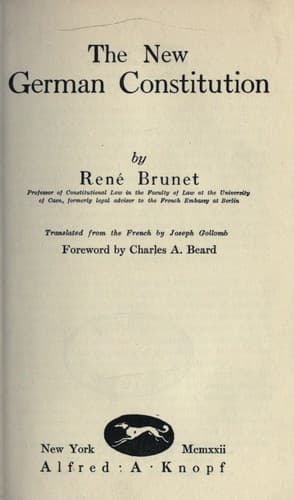
Germany -- Politics and government -- 1918-1933; Germany. Verfassung (1919)
The co-operative societies of producers and of consumers and associations
thereof shall be incorporated, at their request and after consideration
of their form of organization and peculiarities, into the system of
collectivism.
ARTICLE 157
Labour is under the special protection of the Commonwealth.
The Commonwealth will adopt a uniform labour law.
ARTICLE 158
Intellectual labour, the rights of the author, the inventor and the
artist enjoy the protection and care of the Commonwealth.
The products of German scholarship, art, and technical science shall also
be recognized and protected abroad through international agreement.
ARTICLE 159
The right of combination for the protection and promotion of labour and
economic conditions is guaranteed to everybody and to all professions.
All agreements and measures which attempt to limit or restrain this
liberty are unlawful.
ARTICLE 160
Any one employed on a salary or as a wage-earner has the right to the
leave necessary for the exercise of his civil rights and, so far as the
business is not substantially injured thereby, for performing the duties
of public honorary offices conferred upon him. To what extent his right
to compensation shall continue will be determined by law.
ARTICLE 161
For the purpose of conserving health and the ability to work, of
protecting motherhood, and of guarding against the economic effects of
age, invalidity and the vicissitudes of life, the Commonwealth will adopt
a comprehensive system of insurance, in the management of which the
insured shall predominate.
ARTICLE 162
The Commonwealth commits itself to an international regulation of the
legal status of the workers, which shall strive for a standard minimum of
social rights for the whole working class of the world.
ARTICLE 163
Every German has, without prejudice to his personal liberty, the moral
duty so to use his intellectual and physical powers as is demanded by the
welfare of the community.
Every German shall have the opportunity to earn his living by economic
labour. So long as suitable employment can not be procured for him, his
maintenance will be provided for. Details will be regulated by special
national laws.
ARTICLE 164
The independent agricultural, industrial, and commercial middle class
shall be fostered by legislation and administration, and shall be
protected against oppression and exploitation.
ARTICLE 165
Wage-earners and salaried employés are qualified to co-operate on
equal terms with the employers in the regulation of wages and working
conditions, as well as in the entire economic development of the
productive forces. The organizations on both sides and the agreements
between them will be recognized.
Public-domain text, read in full here on John Shaqi.
Reviews
Reviews
No reviews yet
Be the first to share your thoughts on this work.
Elsewhere in the archive
Join the Discussion
Join the discussion
Sign in to leave a comment or review.
Sign InorCreate an account