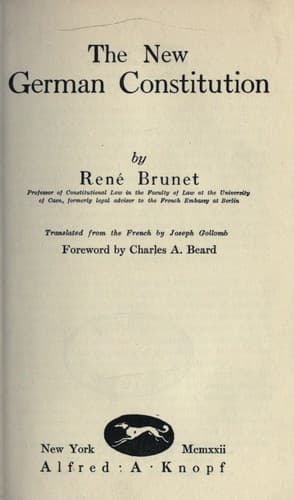
Germany -- Politics and government -- 1918-1933; Germany. Verfassung (1919)
The wage-earners and salaried employés are entitled to be represented
in local workers’ councils, organized for each establishment in the
locality, as well as in district workers’ councils, organized for each
economic area, and in a National Workers’ Council, for the purpose of
looking after their social and economic interests.
The district workers’ councils and the National Workers’ Council meet
together with the representatives of the employers and with other
interested classes of people in district economic councils and in a
National Economic Council for the purpose of performing joint economic
tasks and co-operating in the execution of the laws of socialization.
The district economic councils and the National Economic Council shall
be so constituted that all substantial vocational groups are represented
therein according to their economic and social importance.
Drafts of laws of fundamental importance relating to social and economic
policy before introduction [into the National Assembly] shall be
submitted by the National Cabinet to the National Economic Council for
consideration. The National Economic Council has the right itself to
propose such measures for enactment into law. If the National Cabinet
does not approve them, it shall, nevertheless, introduce them into the
National Assembly together with a statement of its own position. The
National Economic Council may have its bill presented by one of its own
members before the National Assembly.
Supervisory and administrative functions may be delegated to the workers’
councils and to the economic councils within their respective areas.
The regulation of the organization and duties of the workers’ councils
and of the economic councils, as well as their relation to other social
bodies endowed with administrative autonomy, is exclusively a function of
the Commonwealth.
_SECTION VI_
TRANSITIONAL AND FINAL PROVISIONS
ARTICLE 166
Until the establishment of the National Administrative Court, the
National Judicial Court takes its place in the organization of the
Electoral Commission.
ARTICLE 167
The provisions of Article 18, Paragraphs 3 to 6, become effective two
years after the promulgation of the national Constitution.
ARTICLE 168
Until the adoption of the State law as provided in Article 63, but at the
most for only one year, all the Prussian votes in the National Council
may be cast by members of the State Cabinet.
ARTICLE 169
The National Cabinet will determine when the provisions of Article 83,
Paragraph 1, shall become effective.
Temporarily, for a reasonable period, the collection and administration
of customs-duties and taxes on articles of consumption may be left to the
States at their discretion.
ARTICLE 170
The Postal and Telegraphic Administrations of Bavaria and Wurtemberg will
be taken over by the Commonwealth not later than April 1, 1921.
Public-domain text, read in full here on John Shaqi.
Reviews
Reviews
No reviews yet
Be the first to share your thoughts on this work.
Elsewhere in the archive
Join the Discussion
Join the discussion
Sign in to leave a comment or review.
Sign InorCreate an account