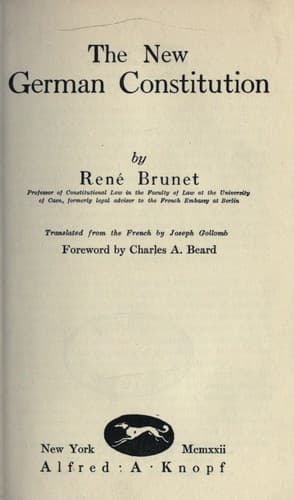
Germany -- Politics and government -- 1918-1933; Germany. Verfassung (1919)
In so far as reference is made in laws or executive orders to provisions
and institutions which are abolished by this Constitution, their places
are taken by the corresponding provisions and institutions of this
Constitution. In particular, the National Assembly takes the place of
the National Convention, the National Council that of the Committee of
the States, and the National President elected by authority of this
Constitution that of the National President elected by authority of the
law relating to the provisional government.
The power to issue executive orders, conferring upon the Committee of
the States in accordance with the provisions heretofore in effect, is
transferred to the National Cabinet; in order to issue executive orders
it requires the consent of the National Council in accordance with the
provisions of this Constitution.
ARTICLE 180
Until the convening of the first National Assembly, the National
Convention will function as the National Assembly. Until the inauguration
of the first National President the office will be filled by the National
President elected by authority of the law relating to the provisional
government.
ARTICLE 181
The German People have ordained and established this Constitution by
their National Convention. It goes into effect upon the day of its
promulgation.
SCHWARZBURG, August 11, 1919
(_Signed_)
The National President
EBERT
The National Cabinet
BAUER
ERZBERGER
HERMANN MÜLLER
DR. DAVID
NOSKE
SCHMIDT
SCHLICKE
GIESBERTS
DR. MAYER
DR. BELL
FOOTNOTES
[1] Prussia, Bavaria, Saxony, Wurtemberg, Baden, Hesse,
Mecklenburg-Schwerin, Saxe-Weimar, Mecklenburg-Strelitz, Oldenburg,
Brunswick, Saxe-Meiningen, Saxe-Altenburg, Saxe-Coburg-Gotha, Anhalt,
Schwarzburg-Rudolstadt, Schwarzburg-Sondershausen, Waldeck, Reuss (elder
line), Reuss (younger line), Schaumburg-Lippe, Lippe, Lübeck, Bremen and
Hamburg.
[2] See Joseph-Barthelémy, _les Institutions politiques de l’Allemagne
contemporaine_, Paris, Alcan, 1915.
[3] See Laband, _Die geschichtliche Entwicklung der Reichsverfassung_ in
the _Jahrbuch des oeffentlichen Rechts_, 1907, p. 1, _et seq._
[4] Piloty, _Die Umformung der Reichsregierung und die Reichsverfassung,
Deutsche Juristen Zeitung_, 1918, p. 651, _et seq._; Stier-Somlo,
_Reichsverfassung_, p. 6.
Page 13, footnote 1. See the text of these claims in Gentizon, _la
Révolution allemande_. 1 vol. Payot, Paris, 1919, p. 222.
[5] It is interesting to note that with the exception of Barth all these
men were members of the Reichstag before the Revolution.
[6] See Jean de Granvilliers, _Essai sur le libéralisme allemand_, Paris,
1914.
[7] See page 73, _et seq._, of this book.
Public-domain text, read in full here on John Shaqi.
Reviews
Reviews
No reviews yet
Be the first to share your thoughts on this work.
Elsewhere in the archive
Join the Discussion
Join the discussion
Sign in to leave a comment or review.
Sign InorCreate an account