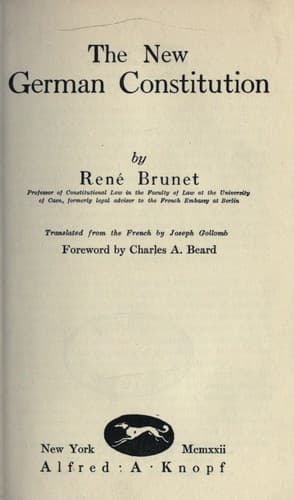
Germany -- Politics and government -- 1918-1933; Germany. Verfassung (1919)
[8] German jurists get much pleasure in pointing out the following
constitutional curiosity: the condition necessary for a law enacted by
a parliament to become operative is that this law shall be promulgated,
that is to say, authenticated and published. But these operations suppose
a government. Now, the law of February 10, created the government;
but this law could not be promulgated by a government which this very
promulgation would create. It was decided, therefore, that the law should
become operative immediately and be authenticated by the President of the
National Assembly.
[9] These concepts of “unitarism” and “federalism” must be compared with
“centralism” and “particularism,” which correspond to them, but which,
nevertheless, also differ from them. When one speaks of “particularism”
one means, beyond the legal and political differences which may exist
between the member states of a federated state, the peculiarities
of race, special traits of culture, geographic and ethnographic
characteristics which give to populations their own stamp and a
distinct collective sentiment. Political “particularism” and federalist
tendencies may co-exist naturally; but “particularism” is not necessarily
anti-centralistic: a “particularism” inspired by the love of a little
fatherland and its individuality gives to the population a certain
national consciousness which is not necessarily antagonistic to the
establishment of a strong central power. On the other hand “unitarism,”
if it preserves for the state the character of a federated state and does
not tend to a complete fusion of the member states, may well recognize
that races and provinces wish for individual existence and may be ready
to accord them corresponding liberty.
[10] See Preuss, _Deutschlands republikanische Reichsverfassung_, p. 8.
[11] See Jacobi, _Einheitsstaat oder Bundesstaat_, Leipzig, 1919.
[12] Since the Revolution, Coburg has detached itself from
Saxe-Coburg-Gotha and become a distinct state without the decision of any
authority whatsoever sanctioning this situation.
[13] There was in this a true provisionally federated state within a
federal German state. For several months there was thus, in central
Germany, a triple superposition of states.
[14] It must be recognized nevertheless that with the exception of the
Hanseatic cities the monarchical form was implied. For Prussia it was
obligatory.
[15] See Giese, _Die Reichsverfassung, vom II, August, 1919_, p. 65;
Jacobi, _Einheitsstaat oder Bundesstaat_, p. 6, _et seq._; Poetsch,
_Handausgabe der Reichsverfassung_, p. 25, _et seq._; Wenzel, _Festgabe
für Bergbohn_, 1919, p. 159, _et seq._
[16] See Stier-Somlo, _op. cit._, p. 79, _et seq._; Walter Jellinek,
Revolution und Reichsverfassung, in Jahrbuch des öffentlichen Rechts, p.
81; Arndt, Reichsverfassung, 1919, p. 35.
Public-domain text, read in full here on John Shaqi.
Reviews
Reviews
No reviews yet
Be the first to share your thoughts on this work.
Elsewhere in the archive
Join the Discussion
Join the discussion
Sign in to leave a comment or review.
Sign InorCreate an account