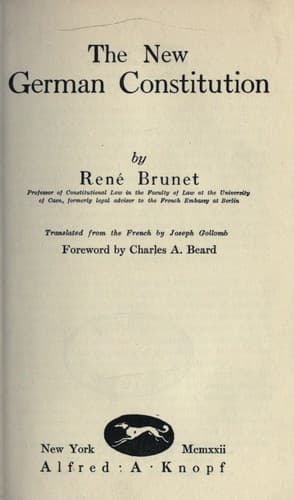
Germany -- Politics and government -- 1918-1933; Germany. Verfassung (1919)
punishments for all violations of these obligations due to ill-will. 8.
The dissolution of all counter-revolutionary military organizations that
did not remain faithful to the Constitution, and their replacement with
organizations recruited from the masses of tried republican population,
in particular workers, salaried employés and organized civil servants,
without favour to any class whatever. In this reorganization the rights
of all troops and organizations that have remained faithful shall remain
intact.”
[21] Retreat of the Berlin troops to the line of the Spree; the lifting
of the state of siege; no attack on armed workers, particularly in the
Ruhr; negotiations with labour organizations with the view of recruiting
of workers in the troops of Prussian safety police.
[22] The principal of the new “Nine Points” are: 1. The troops of
_Reichswehr_ remain in their position and must not advance on the
industrial area except with the express authorization of the Cabinet.
2. The red army dissolves and gives up its arms. 3. Adequate police is
assured by the constitutional authorities, supported by “committees
on public order” and of “local armies” composed of workers, salaried
employés and civil servants of all parties. 4. The “committees of action”
and the “executive committees” are dissolved.
[23] _Deutsche Allgemeine Zeitung_, March 28, 1920.
[24] _Lokal Anzeiger_, April 8, evening.
[25] Lensch, _Erwünschte Nachwirkungen_, in _Der Tag_, No. 83.
[26] Preuss, _Deutschlands republikanische Reichsverfassung_.
[27] Session of July 2. (Heilfron, _op. cit._, vol. V, pp. 2960-2961.)
[28] There are differences of detail between these two modes, but of no
importance.
[29] The origin of this provision goes back to the “certificate” that
was given in the elections for the National Assembly to soldiers and
sailors returning from the front and to troops assigned to service for
the preservation of order in polling places.
[30] Session of July 7, 1919. (Heilfron, _op cit._, vol. V, p. 3314.)
[31] Session of July 7, 1919. (Heilfron, _op. cit._, vol. V, pp.
3299-3300.)
[32] See the analysis of this bill in the _Deutsche Juristen Zeitung_,
1920, p. 385.
[33] Heilfron, _op. cit._, vol. II, p. 969.
[34] _Reichsgesetzblatt_, 1920, p. 909.
[35] Bismarck was always against the granting of salaries to members of
the Reichstag. He hoped thereby to prevent making of politics a career.
The members of the Reichstag since 1906 have been receiving compensation
which, at first fixed at 3,000 marks a year, was increased in 1918 to
5,000. National Assembly members were paid 1,000 marks a month. The new
Reichstag in one of its first sessions decided (1) that its members are
to receive 1,500 marks a month; (2) that those of its members who, in
the intervals of the Reichstag’s sitting, worked on committees, should
receive 50 marks a day. In addition, members of the Reichstag have the
right to travel free on all railroads of the Reich.
Public-domain text, read in full here on John Shaqi.
Reviews
Reviews
No reviews yet
Be the first to share your thoughts on this work.
Elsewhere in the archive
Join the Discussion
Join the discussion
Sign in to leave a comment or review.
Sign InorCreate an account