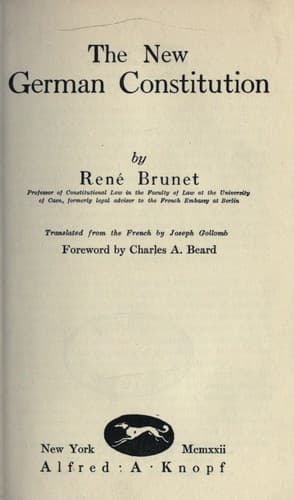
Germany -- Politics and government -- 1918-1933; Germany. Verfassung (1919)
[36] There were formerly six important permanent committees: on
procedure, petitions, commerce and industry, finance and customs,
justice, and budget. We shall see that the Constitution has added to this
list a committee on foreign affairs, and a committee on the protection of
the rights of popular representation when the Reichstag is not meeting.
It goes without saying that the Reichstag may name special committees for
such and such functions decided upon.
[37] There are thus three kinds of treaties: Those made by a law of the
Reich, those made by agreement between the President and the Reichstag,
and those made by the President alone.
[38] It must be noted that, contrary to the practice in most
parliamentary countries, there is no distinction made between ordinary
laws and fiscal laws. The latter, particularly the budget, audit laws,
loans, are subject to the same regulation as the former. This is
explained by the fact that, unlike most other parliamentary countries,
Germany does not practice, properly speaking, the two-chamber system.
[39] Heilfron, _op. cit._, vol. V, p. 3193.
[40] See in general the work of Redslob, _Die parlamentarische Regierung
in ihrer wahren und in ihrer unechten Form_, Tübingen, 1918. It is
curious to note that every argument and all the investigations of Redslob
take as their point of departure the criticisms addressed by Professor
Duguit against the French system, particularly in his _Traité de Droit
Constitutionnel_, 1911, vol. I, pp. 411-412.
[41] This law has never been applied. President Ebert, now in office,
was, it will be remembered, elected by the National Assembly.
[42] The President of the Reich has not, what is called in France, _le
pouvoir réglementaire_, that is to say, the right to issue general
ordinances obligatory on all citizens. He cannot make regulations of this
kind except in cases where the Constitution or an ordinary law gives him
special power to do so. In such a case either he issues the regulation,
naturally with the countersignature of a Minister (Articles 48, 49, 51,
59 of the Constitution, for example), or he must first obtain the consent
of the Reichstag.
[43] See particularly the decree of March 19, 1920, _Reichsgesetzblatt_,
1920, p. 467.
[44] At the meeting of the Committee on the Constitution on April 4,
1919, Preuss, then Minister of the Interior, declared that such was
already the practice in Germany and that President Ebert presided over
the most important meetings of the Council of Ministers.
[45] It includes in addition two members that do not belong to any
party--the Minister of Foreign Affairs and the Minister of Transport.
Public-domain text, read in full here on John Shaqi.
Reviews
Reviews
No reviews yet
Be the first to share your thoughts on this work.
Elsewhere in the archive
Join the Discussion
Join the discussion
Sign in to leave a comment or review.
Sign InorCreate an account