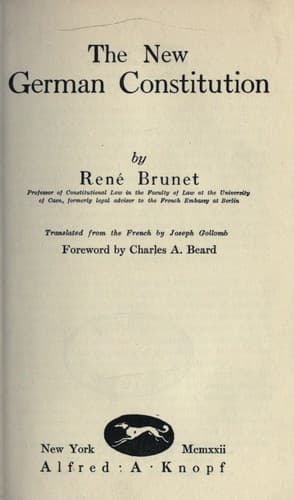
Germany -- Politics and government -- 1918-1933; Germany. Verfassung (1919)
[49] It should be observed that this provision has been decreed by a
law; consequently there can be no question in regard to it whether it
is a provision having the force of law or only a moral maxim. It is a
legislative provision. The fact that it was later inserted into the
Constitution has only the effect of preventing its abrogation or its
modification other than by constitutional amendment.
[50] This principle of civil law has also become now a provision of
constitutional law (Article 152).
[51] It must be also noted that up to now the States have not as yet
complied with this order of the Constitution. In Prussia in particular
it does not seem that measures have yet been enacted against the
“fideicommis.”
[52] _Reichsgesetzblatt_, 1920, p. 876.
[53] The question of the length of the working day has not been touched
by the Constitution. Up to now it has been regulated exclusively by
special decrees based on the eight-hour day. The decrees of November
23, 1918, and of December 17, 1918, introduced the eight-hour day for
workers in industries with the exception of industries which must not be
interrupted. The decree of November 23, 1918, prescribed the length of
the working day in bakeries; that of March 18, 1919, did the same for
salaried employés. A general law that provides for an eight-hour day and
regulating its application is in preparation.
[54] _Reichsgesetzblatt_, 1920, p. 98.
[55] As yet there has not been organized insurance against non-employment.
[56] The political parties interested themselves in these elections, the
platform being “for or against religious instruction.” The number of
socialists elected was less than that of bourgeois parties.
[57] See Chapter III.
[58] Max Schippel, _Schicksalstunden der Arbeitsgemeinschaft,
Sozialistische Monatshefte_, 1920, p. 328.
[59] It has been changed by a law of May 31, 1920. (_Reichsgesetzblatt_,
1920, p. 1128.)
[60] _Deutsche Allgemeine Zeitung_, April 29, evening.
[61] In the discussion that arose on this subject an expression used in
it has achieved popularity and is in current use. The strikers demanded
and obtained the “anchorage” of the Councils in the Constitution.
[62] See p. 307.
[63] It will be recalled that in order to obtain increase in authority
for the Factory Workers Councils, the Independents organized a great
manifestation in Berlin in January, 1920, in the course of which about
forty of the participants in the manifestation were killed on the steps
of the Reichstag.
[64] These enterprises are: Stock companies, limited joint-stock
companies, mutual insurance companies, and eventually limited liability
companies.
[65] See Paul Umbreit, _das Betriebsrätegesetz_, Berlin, 1920, pp. 20-21.
[66] It met for the first time on June 30, 1920.
Public-domain text, read in full here on John Shaqi.
Reviews
Reviews
No reviews yet
Be the first to share your thoughts on this work.
Elsewhere in the archive
Join the Discussion
Join the discussion
Sign in to leave a comment or review.
Sign InorCreate an account