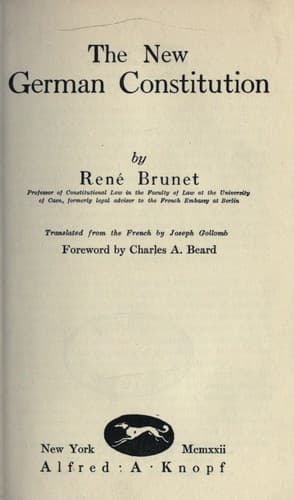
Germany -- Politics and government -- 1918-1933; Germany. Verfassung (1919)
[67] This memorandum did not represent the personal opinion of the
Minister. The ideas expressed in it were the opinions of a group that
included both socialists and bourgeois elements, men like Walter
Rathenau, von Möllendorf (under-secretary of State under Wissel),
Andreas, a banker, Georg Bernhard, editor of the _Vossiche Zeitung_, and
others.
[68] Reier, _Sozialisierungsgesetze_, Berlin, 1920, p. 14.
[69] Wissel, then Minister of Public Economy, on March 7, 1919, before
the National Assembly thus defined collective economy properly so-called:
“Collective economy means the organization and management of private
economic enterprises in the interests of the Reich, the subordination
of private interests to collective interests. The application of this
general principle to particular cases must be adapted to the special
conditions of the different branches of the economy. Nothing can be worse
than to want to make the economy rigidly uniform. Every economic group is
a different organism that demands forms appropriate to it. This seems to
be indicated in the exterior forms of union, such as capitalist economy
practiced in its associations and cartels. But the spirit that prevails
in these organizations must be raised above purely private considerations
up to a sense of responsibility toward the people as a whole, up to the
conception of a collective economy. _Collective economy does not mean
state economy, but autonomy._ The State is not the master of economy. It
can and should exercise supreme supervision and hold in equilibrium the
opposing interests with justice and wisdom.”
[70] These sixty members are divided as follows:
3 representatives of states;
15 representatives of colliers’ organizations;
15 representatives of mine workers;
1 employer and 1 worker in gasworks;
2 salaried employés of the technical service of the mines;
1 salaried employé of the commercial service of the mines;
5 coal merchants;
1 employé in the wholesale coal trade;
2 employers and 2 workers in industries using coal;
2 representatives of consumers’ societies;
1 user of coal in the cities, 1 in the country;
2 representatives of small industries using coal;
1 user of coal for railroads;
1 user of coal for maritime navigation;
1 user of coal for river navigation;
3 mine and boiler experts.
Public-domain text, read in full here on John Shaqi.
Reviews
Reviews
No reviews yet
Be the first to share your thoughts on this work.
Elsewhere in the archive
Join the Discussion
Join the discussion
Sign in to leave a comment or review.
Sign InorCreate an account