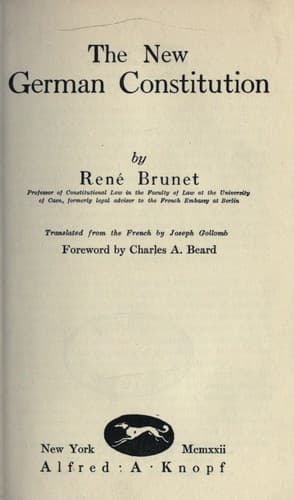
Germany -- Politics and government -- 1918-1933; Germany. Verfassung (1919)
The representatives of the states are named by the Reichsrat from among
the municipal administrations and consumers of coal. The representatives
of employers and employés in the mining industries as well as the twelve
representatives of the colliers’ associations are elected by the mine
groups of the _Arbeitsgemeinschaft_. Two representatives are named by the
Prussian Minister of Commerce and Industry. The representatives of the
coal trade are named by the German Congress of Commerce and Industry. The
representatives of the employers and employés of the industries using
coal, and the representatives of the employés of gasworks are elected
by their _Arbeitsgemeinschaften_. The representatives of the small
industries using coal are elected by the German Chambers of Commerce and
Industry. The other representatives are appointed, on the advice of those
they represent, by the Minister of Public Economy of the Reich.
[71] Stricken out at the demand of the Supreme Council of the Allied and
Associated Powers. The Supreme Council addressed the following demand to
Germany on September 2, 1919:
“The Allied and Associated Powers have examined the German Constitution
of August 11, 1919. They observe that the provisions of the second
paragraph of Article 61 constitute a formal violation of Article 80 of
the Treaty of Peace signed at Versailles on June 28, 1919. This violation
is twofold:
“1. Article 61 by stipulating for the admission of Austria to the
Reichsrat assimilates that Republic to the German States composing the
German Empire--an assimilation which is incompatible with respect to the
independence of Austria.
“2. By admitting and providing for the participation of Austria in the
Council of the Empire Article 61 creates a political tie and a common
political action between Germany and Austria in absolute opposition to
the independence of the latter.
“In consequence the Allied and Associated Powers, after reminding the
German Government that Article 178 of the German Constitution declares
that ‘the provisions of the Treaty of Versailles can not be affected by
the Constitution,’ invite the German Government to take the necessary
measures to efface without delay this violation by declaring Article 61,
Paragraph 2, to be null and void.
“Without prejudice to subsequent measures in case of refusal, and in
virtue of the Treaty of Peace (and in particular Article 29), the Allied
and Associated Powers inform the German Government that this violation of
its engagements on an essential point will compel them, if satisfaction
is not given to their just demand within 15 days from the date of the
present note, immediately to order the extension of their occupation on
the right bank of the Rhine.”
Article 29 of the Treaty of Peace refers to Map No. 1 which shows the
boundaries of Germany and provides that the text of Articles 27 and 28
will be final as to those boundaries. Article 80 reads as follows:
Public-domain text, read in full here on John Shaqi.
Reviews
Reviews
No reviews yet
Be the first to share your thoughts on this work.
Elsewhere in the archive
Join the Discussion
Join the discussion
Sign in to leave a comment or review.
Sign InorCreate an account