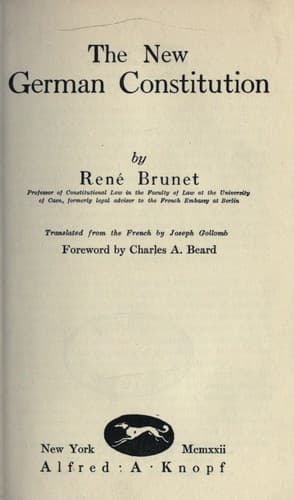
Germany -- Politics and government -- 1918-1933; Germany. Verfassung (1919)
However, the Commission of States differed in other respects from the
Bundesrat, especially in authority. It is true that as formerly no law
could be enacted except with the approval of the Assembly. But now the
centre of gravity of political power passed from the Assembly of States
to the popular assembly. From this came the following consequences:
formerly if a projected law emanating from the Presidency of the Empire
did not secure a majority in the Bundesrat it could not be considered
by the Reichstag, and was thereby definitely buried. Whereas now the
government could submit for decision by the National Assembly a project
which had been rejected by the Commission of States. Formerly, too, in a
disagreement between the two assemblies over a projected law which the
Reichstag had accepted but the Bundesrat had rejected, the last word
rested with the negative party, that is to say, the Bundesrat, where
naturally the project was buried. Now, however, the government was never
bound by a decision of the majority of the Commission of States and it
could always bring a project up again before the National Assembly, which
had been defeated in the Commission. The members of the government of the
Reich and those of the Commission of States had the right to participate
in the National Assembly and defend their respective points of view;
but it was the National Assembly that always made the final decision.
If, however, a discord between the two Assemblies could not be broken
the President of the Reich had the right to submit this difference to a
popular referendum for decision. This situation, however, has not as yet
presented itself.
The differences between the former Bundesrat and the new Commission of
States were considerable. The champions of a united Reich criticized the
Commission as an obstacle to the foundation of a united German Republic
and this objection seemed from their point of view justifiable. It must
be noted also that the provisional constitution does not specify which,
the state’s parliament or its government, in each member state nominates
the delegates to the Commission. We know only that the members of the
Commission of States had an imperative mandate, for its representatives
defended the point of view of their governments.
A law became operative when it was adopted by both the National Assembly
and the Commission of States.
* * * * *
3. THE PRESIDENT OF THE REICH.--The Provisional Constitution placed at
the head of the Reich a president.
The president of the Reich had to be elected by an absolute majority of
the National Assembly. He was to remain in power until the inauguration
of the president elected in conformity with the permanent constitution.
To avoid discussions which would retard the adoption of the law and not
to have to specify the powers of the president the provision attributed
to him generally the powers of a chief of state in a modern republic.
Public-domain text, read in full here on John Shaqi.
Reviews
Reviews
No reviews yet
Be the first to share your thoughts on this work.
Join the Discussion
Join the discussion
Sign in to leave a comment or review.
Sign InorCreate an account