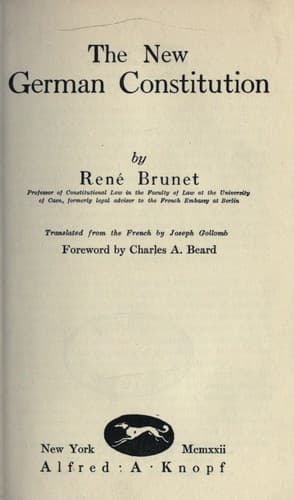
Germany -- Politics and government -- 1918-1933; Germany. Verfassung (1919)
It would be difficult to imagine anything more illuminating than a
comparison of the Constitution of the United States drawn up in 1787, the
fundamental law of the Australian Commonwealth adopted in 1900, and the
new German _Reichsverfassung_ of 1919, which vibrates with the tramp of
the proletariat. In the attempt of the Germans to combine the strength
of Hamilton’s government with the democratic control so vaunted by
Jefferson we have an experiment that ought to stir our deepest interest.
In the provisions for social, not to say socialistic, enterprise, both
the Australian and the German constitutions offer noteworthy contrasts
to our own fundamental law. It will not escape the close observer that
the Germans have not created a supreme court, on the model of our own,
endowed with power to set aside acts of the executive and legislative
branches of the government. The relations established by the Germans
between the federal government and the states, ingenious compromises all
must admit, ought to be studied in connection with Mr. Roosevelt’s “New
Nationalism”--not as an echo of a dead past but as a prophecy of the
future.
The science of comparative government is as fruitful to-day as it was a
generation ago when it nourished in such vigour. A teacher who will place
M. Brunet’s book and “The Federalist” in the hands of a college class
cannot fail to evoke a lively interest in politics and a more intelligent
consideration of American constitutional problems.
To the historian, the introductory part of M. Brunet’s volume will
afford food for thought. There is no doubt that the new German
constitution is the product of a sharp and determined conflict of
classes. M. Brunet records the fact and gives the alignment of parties.
No sophisticated person will ever imagine (whatever he may say) that
the German fundamental law was drawn from abstract political thinking,
theories about the rights of states, or reflections on the fate of Greek
democracies and ancient Rome. The pressure of class interests is evident
in almost every line. If one should underscore the socialist sections
with red, the Centre clauses with yellow, and the capitalist phrases with
black, one would have an interesting study in constitutional artistry.
From time to time, M. Brunet makes specific references to the precise
effect of party pressures upon legal phraseology. It would, however, be
a work of supererogation to point out to American scholars the relevancy
of these passages. Having recovered from the shock of learning that the
Fathers of our Constitution were made of mortal clay, they are prepared
to receive M. Brunet’s book with open minds.
Public-domain text, read in full here on John Shaqi.
Reviews
Reviews
No reviews yet
Be the first to share your thoughts on this work.
Join the Discussion
Join the discussion
Sign in to leave a comment or review.
Sign InorCreate an account