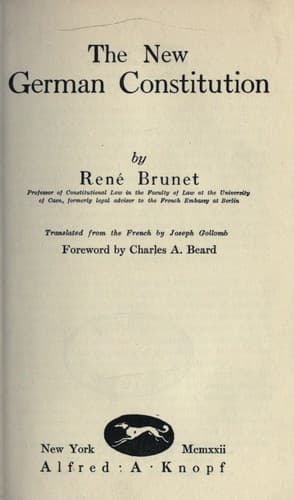
Germany -- Politics and government -- 1918-1933; Germany. Verfassung (1919)
The other jurists emphasize the characteristics of the States which bring
them nearer in nature to states properly so called. The Constitution has
recognised that if sovereignty in the Reich emanates from all the people,
sovereignty in the states also emanates directly from the people of those
states. From this it follows as a logical consequence that this power is
exercised within the states, in the matters within their jurisdiction
and through the organs of the states on the basis of their Constitution.
The Constitution has admitted that the states have their own proper
territory since the territory of the Reich is composed of the territories
of the state. The latter have also their own individual legislative and
administrative organizations. It need only be added that if the Reich
disappeared the states could still subsist and continue to live according
to their Constitutions, which proves that their sovereignty belongs
to them and is not surrendered to the Reich. Finally, and this is the
essential argument, in the Reichstag the states are represented as such
and as such they participate in the formation of the will of the Reich.
This makes it, therefore, a federated state.[16]
The National Assembly did not want to take a position on this question
and of its own accord adopted an entirely colourless declaration on it
which left the doors open to all opinions. While the individual states
were called in the Constitution of 1871 “federated states,” they were
thereafter called “republics” in the Preuss draft, “member-states” in the
draft submitted by the government and finally “länder” in the draft of
the constitutional commission and in the definitive text.
Actually, however, it is difficult to understand the interest in this
question. What difference does it make whether the states are states or
provinces, so long as their powers and obligations are strictly defined
by the Constitution? From their names alone we can deduce nothing
practically informative about their nature. It is an academic question
which has not progressed one step in three generations, which one studies
but does nothing about, for there is no reality in it.
In fact it is not possible to indicate a precise and material criterion
according to which one should differentiate between a state and an
autonomous province which is not entitled to the name of state.
There are no clearly defined categories which one can label once for all
and among which one can distribute the different state and provincial
collectivities.
Public-domain text, read in full here on John Shaqi.
Reviews
Reviews
No reviews yet
Be the first to share your thoughts on this work.
Join the Discussion
Join the discussion
Sign in to leave a comment or review.
Sign InorCreate an account