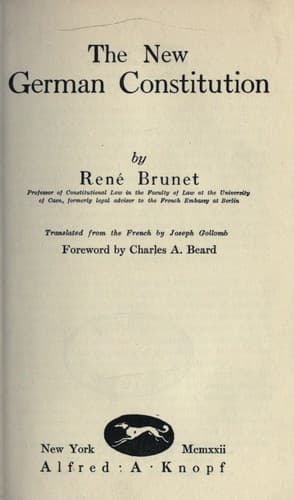
Germany -- Politics and government -- 1918-1933; Germany. Verfassung (1919)
But it cannot be a parliament having rights equal to those
of a political parliament.
* * * * *
Such are the objections put forward by democrats against the institution
of a Chamber of Labour, and their force cannot be denied. But the
champions of an economic parliament reply with vigour.
These objections, say they, all take the point of view of _formal
democracy_, that is to say, the point of view that considers only
the external forms of democracy, which contents itself with a purely
theoretical equality of right and equality between citizens corresponding
not at all to the facts of reality, which reduce this equality to
nothing. To this form of democracy, to-day condemned by reality, there
must be opposed _real democracy_, in which one takes into account the
special rôle which certain elements in the life of a nation play. Formal
democracy has been fully realized by giving all men and women the right
to vote. That is not enough. In a modern democracy public economy must be
given its proper place, which is in the forefront. Producers, as such,
must play the preponderant rôle in the state, for the other members of
the community live only as parasites on their labour, and the state does
not exist except by the labor of the producers. No decision can be taken
in a state if it is not accepted by the producers; the latter must be the
touchstone of all decisions.
It is not because of their technical competence that producers are
proposed as the constituents of a special chamber. _It is because they
judge things from the point of view of production_, which in a modern
democracy should count more than any other. It is not a question of
abolishing the political parliament, but of placing in juxtaposition to
it an economic parliament through which the voice of the producers can be
heard and by which the ideology of the politicians can be corrected by
the realism of men of affairs.
No division of competence between the two parliaments in such a way that
only social and economic questions shall be submitted to the Chamber
of Labour can be admitted. This distinction between political affairs
and economic affairs is a pure impossibility, for economy, politics
and general culture form a unity which must be respected. It is on
production, on “creation” that the existence of the people and all its
material and intellectual life rests. The two parliaments therefore
should have equal power to study these questions. They must also have
equal rights. To give the economic chamber only the right to draw up
reports and give advice, and even to oppose its veto only, would be
entirely insufficient and would not correspond to the primary rôle which
the producers play in the life of a nation.
Public-domain text, read in full here on John Shaqi.
Reviews
Reviews
No reviews yet
Be the first to share your thoughts on this work.
Elsewhere in the archive
Join the Discussion
Join the discussion
Sign in to leave a comment or review.
Sign InorCreate an account