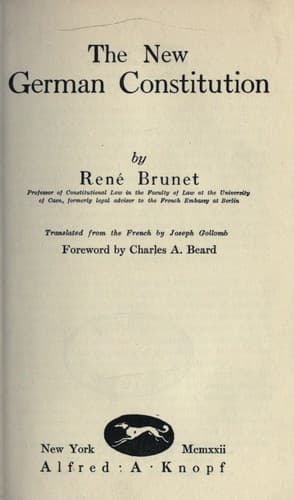
Germany -- Politics and government -- 1918-1933; Germany. Verfassung (1919)
It is superfluous, continue the partisans of a Vocational Parliament, to
present arguments of which history constantly furnishes corroboration. In
the countries which practise the system of two chambers, one of the two
chambers takes on always a greater importance than the other and plays
the preponderant rôle. It is the one which translates best the will of
the nation and best satisfies its needs. The other chamber may be able to
resist for some time but in the end it is always forced to surrender. Up
to now this preponderant rôle has been held by the lower houses, which
being the product of universal suffrage, are always nearer the people,
have more of their confidence and reflect more exactly their aspirations.
Let us create now by the side of the former lower chamber, a Chamber of
Labour and let us leave to it the care of determining its own future.
It will either become a parliament of the privileged, making decisions
that will not correspond to the true needs of the nation; in which case
it will be promptly annihilated by the more popular chamber. Or, on the
other hand, it will show itself to be the more practical and the more
useful chamber to the people. In the inevitable conflicts that will arise
between the two chambers, the economic chamber will have behind it the
support of the people. In case of referendum it will be in favour of the
Chamber of Labour that the national sovereignty will decide; in which
case the traditional rôle of a lower house will pass into the hands of
a Chamber of Labour. The proponents of the Vocational Parliament are
convinced that it will be this last alternative that will be realized.
The German Constituent Assembly has followed their suggestion only to
a very slight measure; sufficiently perhaps to attempt the experiment
recommended by the advocates of the Vocational Parliament. The Assembly
has created an Economic Council, which will be judged by its work,
although it is deprived, according to the Constitution, of any real
political authority. It is sufficient for the moment to say that in
principle it is the classic point of view of formal democracy that guides
it.
4.--THE POLITICAL ACTIVITY OF THE UNIONS.
Meanwhile, however, several things occurred that seemed to support the
arguments of the partisans of a Chamber of Labour, when they claim that
the natural evolution of events must lead shortly to the advent of this
chamber.
Public-domain text, read in full here on John Shaqi.
Reviews
Reviews
No reviews yet
Be the first to share your thoughts on this work.
Elsewhere in the archive
Join the Discussion
Join the discussion
Sign in to leave a comment or review.
Sign InorCreate an account