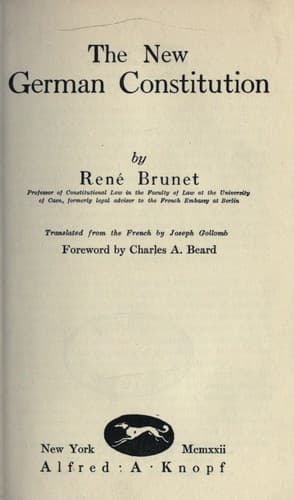
Germany -- Politics and government -- 1918-1933; Germany. Verfassung (1919)
We know that on March 13, 1920, counter-revolutionary troops led by the
Infantry General von Lüttwitz seized Berlin, that the regular government
abandoned the capital and that the Director-General of Agriculture, Kapp,
was proclaimed at the same time Chancellor of the Empire and Premier
of Prussia. It was a _coup de main_ of officers and former reactionary
functionaries, all of whose acts aimed at the re-establishment of the old
régime. On the 14th the unions of workers and clerks sent an ultimatum to
the new masters of Berlin demanding that they immediately withdraw. As
this ultimatum was not obeyed, a general strike was proclaimed on March
15.
The counter-revolutionary government lasted four days; then, conquered by
the general strike, it disappeared.
But before giving the workers and employés the order to return to
work the chiefs of the unions wanted to obtain guarantees against the
return of a new _coup d’état_. They called therefore on March 18 the
representatives of the parties of the majority to a conference, where
they presented to them the following new ultimatum. These representatives
were to accept in the name of their groups--which would therefore be
bound--the claims which would be submitted to them; otherwise the general
strike would be continued in an aggravated form. The unions would not
hesitate, if necessary, to prevent the return to Berlin of the Government
and the National Assembly. They would even accept the responsibility of a
civil war. The representatives of the Democrats and of the Centre refused
to pledge their parties. They promised only to do what they could to get
them to accept the claims of the unions.
As for the claims themselves, they were presented by the union leaders,
and, after a long discussion and some modifications, they were accepted
by the representatives of the political parties. These claims formed the
celebrated agreement known in Germany as the “Eight Points.” They gave
particularly to the unions the right to exercise a veritable veto over
the nomination of Ministers and the formation of the Ministry.[20]
This agreement concluded, the regular government came back to Berlin. But
then came its turn to negotiate with the trade unions and to attempt to
satisfy their new claims.[21] These new engagements secured, the union
leaders ordered the end of the general strike and the resumption of work.
Public-domain text, read in full here on John Shaqi.
Reviews
Reviews
No reviews yet
Be the first to share your thoughts on this work.
Elsewhere in the archive
Join the Discussion
Join the discussion
Sign in to leave a comment or review.
Sign InorCreate an account