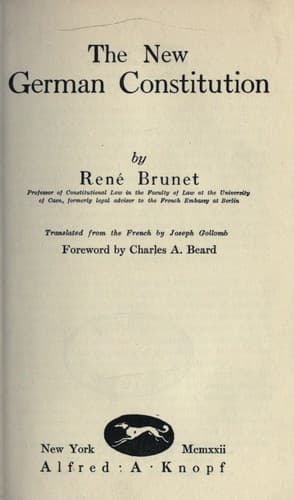
Germany -- Politics and government -- 1918-1933; Germany. Verfassung (1919)
Later the monarchist flag reappeared, rallying about it all the
deceptions and discontents. During the discussion of the draft of the
Constitution the German Nationalists, among them the former Minister
Delbrück, declared loudly that they preferred a constitutional,
parliamentary monarchy to a republican government; but the other parties
did not follow them. In Article 1 of the Constitution it was decided that
“The German Reich is a Republic”; and in Article 17 that “each state must
have a Republican Constitution.”
As a symbol of this change in the form of government the Constitution
changed the colours of the German flag; abandoning the black-white-red
of the old régime and adopting the colours, black, red and gold because
of their historical significance; because these colours had always
symbolized in the courts of the nineteenth century the tendency toward
political liberty and towards German national unity.
However, the Constitution does not give the new German state the name
“Republic” but keeps the name of “Reich.” The Independents protested
against that; they insisted on the fact that “Reich” will be always
translated in French and in English as “Empire” and that this word
will always signify to foreign powers all that militarist domination
implies, the despotic subordination and the dangerous pan-Germanism that
characterized the old Empire. But Preuss, followed by all the other
parties, observed that abroad “Reich” could not be translated as “Empire”
except in bad faith, for Article 1 specifies that Germany is a republic
and that the republican character of the state appears clearly in even
the most casual reading of the text of the Constitution. For him the
distinctive trait of the Constitution was that it places to the forefront
German unity. “After all, our historical development is precisely in the
words ‘Reich’ and ‘German Reich’ with which are associated the efforts
of the German people towards unity and the re-establishment of national
unity. I believe that to keep the word ‘Reich’ is entirely compatible
with the marked emphasis on republican character with which the whole of
the Constitution is impregnated.”[27]
2.--UNIVERSAL SUFFRAGE, THE POLITICAL PARTIES AND THE ELECTORAL LAW.
Democracy being the government of the state by the will of the majority,
the next problem, a difficult one, is how to indicate that will.
Public-domain text, read in full here on John Shaqi.
Reviews
Reviews
No reviews yet
Be the first to share your thoughts on this work.
Elsewhere in the archive
Join the Discussion
Join the discussion
Sign in to leave a comment or review.
Sign InorCreate an account