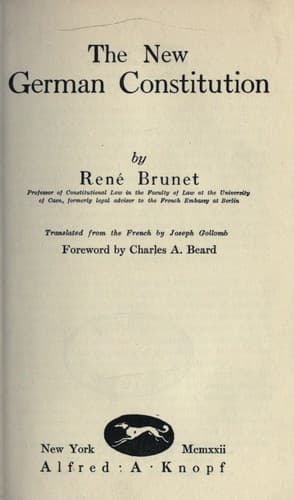
Germany -- Politics and government -- 1918-1933; Germany. Verfassung (1919)
It must be examined, therefore, in concrete fashion how what is rightly
considered as the popular will is expressed in practice in modern
political democracies. If all the processes of this formation are
reduced to their essential elements, discarding all complications that
may introduce error, there is revealed this: the fact that between the
individual and the people as a whole there interposes itself a third
element, the political party. What matter if in some respects one may
think that, even under the most favorable circumstances, it is only
a necessary evil? The political party is a political means not only
indispensable but fecund and perfectly rational. Its essential function
is _to transform isolated volitions into a collective will of the
ensemble_. Therein, too, the apparent contradiction between the fact that
the crowd has no conscious will and the postulate of a popular will is
reconciled. The tendencies of individuals, chaotic as they may be, change
completely in nature when they are joined to equal or similar tendencies
of many other individuals. From the contact of these vague and troubled
impulses there springs forth the conscious and clear collective will.
Certain impulsive forces particularly powerful disengage from others and
unite with adjacent currents to create and to strengthen a movement that
can attract the masses. It is only when chaos is thus organized and when
impulses are thus transformed into forces that these forces acquire a
political significance and can be compared and confronted in a parliament.
Such being the primary function of the political party in a democracy,
positive legislation must be such as to permit it to fulfil this function
in order that the powerful popular will shall be most clearly and easily
clarified and formulated by it. We must examine how this has been
embodied in German law.
* * * * *
In conformity with the democratic principle the Constitution in Article
22 provides: “The delegates are elected by universal, equal, direct
and secret suffrage by all men and women over twenty years of age, in
accordance with the principles of proportional representation. The day
for elections must be a Sunday or a public holiday. The details will be
regulated by the national election law.”
This law is dated April 27, 1920, and was itself followed by an ordinance
on May 1, 1920, which specifies each application.
I.--GENERAL PRINCIPLES.
The system according to which the delegates to the National Assembly were
elected has not given complete satisfaction.
The principal objection made against it was directed above all against
the law of November 30, which permits parties to unite their lists of
candidates, a privilege from which the parties that lent themselves to
neither alliance nor compromise naturally suffered. Such lists have been
criticized as corrupting political morality and obscuring the results of
elections.
Public-domain text, read in full here on John Shaqi.
Reviews
Reviews
No reviews yet
Be the first to share your thoughts on this work.
Elsewhere in the archive
Join the Discussion
Join the discussion
Sign in to leave a comment or review.
Sign InorCreate an account