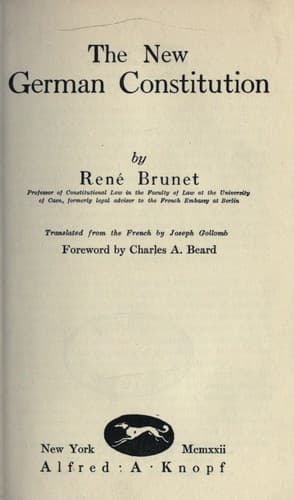
Germany -- Politics and government -- 1918-1933; Germany. Verfassung (1919)
But it has been also estimated that the division of representation in
accordance with the Hondt system permits the stifling of small groups and
that after the apportionment of seats in the different districts there
are votes which secure no representation to the detriment of the small
parties.
It is found also that the division of the territory of the Reich into
electoral districts has been badly done, some districts being in a
general way much too extensive. There are, as a rule, an average of
eleven members per district in the National Assembly, and experience has
shown that this number is too large for the members to be able to know
well the needs of their districts and to maintain close contact with
their electors.
It has been decided to abandon, therefore, the system of Hondt and to
adopt an automatic system which was inscribed in Article 24 in the
Constitution of Baden, and which is more customarily known as the _Baden
System_. It is thus defined in the above-mentioned article: “Each party
or group of electors is allowed one member for every ten thousand
votes cast for its list of candidates. In each district the votes
remaining unused are added up for the whole country and are apportioned
representation according to the principle described above. Every fraction
of more than 7,500 votes is permitted a seat.”
The originality of the system consists in this: First, the number of
members, instead of being fixed according to the number of the population
or of the electors, depends on the number of those actually voting, in
such a way that not until after the elections can one count the number
of members that will make up the assembly. The latter, therefore, will
be more numerous if the electors are more numerous. There is also a
superimposition of the tickets. The votes not utilized in the tickets of
the first degree are reassembled on a list of the second degree where a
new division of seats is made.
Public-domain text, read in full here on John Shaqi.
Reviews
Reviews
No reviews yet
Be the first to share your thoughts on this work.
Elsewhere in the archive
Join the Discussion
Join the discussion
Sign in to leave a comment or review.
Sign InorCreate an account