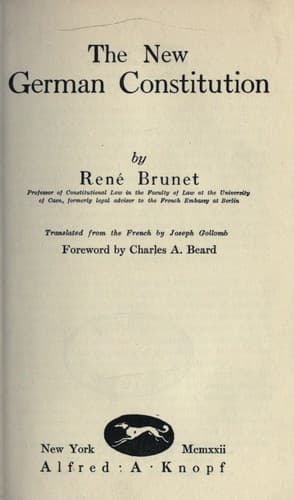
Germany -- Politics and government -- 1918-1933; Germany. Verfassung (1919)
This mechanism represents obvious advantages. It insures to each party
exactly as many members as it should receive according to the number of
votes cast for it throughout the whole state. It realizes the greatest
possible use of remnants of votes, and consequently satisfies as
completely as possible the exigencies of proportional representation. All
attempts by the government or by a majority at a cunning and dishonest
division of the country into artificial electoral districts are thus
eliminated. In addition this system permits the possibility on the part
of parties to give seats to candidates who have exceptional parliamentary
experience and who play political rôles of the first order, but who
despise mixing in local political struggles, such as may be considered
among the principal influences in the lowering of the personal character
of parliament. The ticket of the Reich permits each elector to vote
at the same time for the man in whom the locality has confidence, who
knows the needs of his districts and of his electors, as well as for the
leaders who direct his party.
The system of Baden can be in turn applied in different modes. To give
the public a chance to discuss these modes and to pronounce on this
matter, the government of the Reich in January, 1920, published three
advance projects of electoral law, each project defining and regulating a
particular modality.
Project A introduced the Baden system in its purest form. It provided
for electoral districts in which the number of voters was generally
sufficient to elect six members; the unutilized votes in each district
would be immediately summed up in a ticket for the Reich, where
representation would be apportioned in the same manner as within the
district.
Project B provided for electoral districts of four members each. But
between the district tickets and the ticket for the Reich there would be
a third: several adjoining electoral districts being united in “a group
of districts,” in which lists called “tickets of the groups of districts”
would have to be presented. The unutilized votes in the electoral
districts would be first added up within the “union of districts” and
credited to the ticket of this union. The ticket for the Reich would then
receive only the unutilized fractions of each group.
Public-domain text, read in full here on John Shaqi.
Reviews
Reviews
No reviews yet
Be the first to share your thoughts on this work.
Elsewhere in the archive
Join the Discussion
Join the discussion
Sign in to leave a comment or review.
Sign InorCreate an account