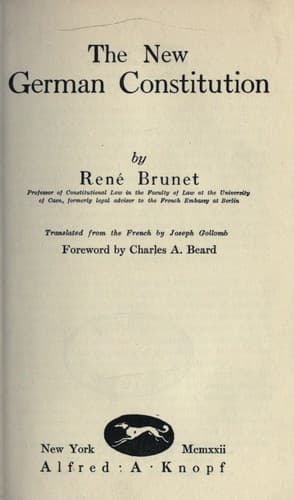
Germany -- Politics and government -- 1918-1933; Germany. Verfassung (1919)
(_c_) The ticket for the Reich receives a member for every 60,000 votes
thereon. Beyond that every fraction in excess of 30,000 is considered
equal to 60,000. But the ticket for the Reich can never obtain more
seats than the total won by the district tickets whose excess fractions
have been united therein; for here, too, the design is to avoid the
possibility that small groups may secure more seats by means of the
ticket of the Reich than they have received by direct votes in the
districts themselves.
The distribution of seats among the candidates of the same ticket is,
because of the system which excludes “splitting” and the joining of
tickets, extremely simple. Those elected are designated according to the
order in which their names appear on the tickets, so that the wish of the
electors has no part in this matter.
V.--THE ACTUAL WORKING OF THE LAW.
The electoral system which we have described was applied for the first
time in the elections to the first Reichstag of the German Republic on
June 6, 1920. From the purely technical point of view it seems to have
worked satisfactorily. It is interesting above all to inquire how the two
principal innovations in these elections have worked out: woman suffrage
and the automatic distribution of seats.
I.--Women already voted in January, 1919, at the elections for the
National Assembly. They voted in considerable numbers. Of the women
eligible to vote 83 per cent did so. The percentage among the men was
82.4, which is approximately the same as the women. But this equality
disappears when we consider the proportion according to the ages of those
voting. Among the male electors twenty years old only 59.6 per cent
voted; whereas among the women of the same age 80.5 per cent voted. Thus
the young women seemed twice as zealous to use the new privileges that
had been accorded to both. Of the electors from twenty-one to twenty-five
years old, 70 per cent of the men and 80.9 per cent of the women voted.
But the statistics change when we come to the older groups. Past the age
of twenty-five it was 84.8 per cent of men that voted, and only 82.6 per
cent of women.
At the elections of June, 1921, fewer women seemed to have voted than the
year before, and this time it was the men who proportionally voted in
larger numbers.
But in 1920 there was tried an experiment in several districts which had
not been done in 1919. The men and women of these districts voted in
separate polling places, in order to determine their respective strength
in the various parties. We will cite, among other facts, two instances
obtained in cities of differing political complexion.
In Cologne 119,263 men and 110,364 women voted in the sections in which
this experiment was carried out. The vote was distributed as follows:
Public-domain text, read in full here on John Shaqi.
Reviews
Reviews
No reviews yet
Be the first to share your thoughts on this work.
Elsewhere in the archive
Join the Discussion
Join the discussion
Sign in to leave a comment or review.
Sign InorCreate an account