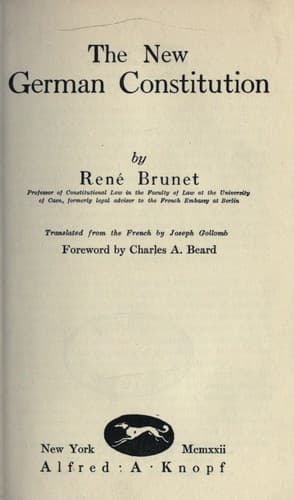
Germany -- Politics and government -- 1918-1933; Germany. Verfassung (1919)
Each party may “join” its tickets; which is distinguished from “groups”
of tickets, such as were allowed in the elections for the National
Assembly. The “group” of tickets was a contract between the signatories
of two or more tickets of different parties, the intention being to
have these tickets considered in the counting of ballots as one and the
same tickets as against other tickets. It was, therefore, an electoral
alliance between different parties within the same district. These unions
of tickets, as we have seen, are now forbidden. The new law, on the other
hand, provides that tickets may be “joined,” that is to say, that a union
may be effected of tickets of the same party within different electoral
districts, in order to utilize best the electoral fractions. In order
to be valid this combination must take place within the same group of
districts and between lists belonging to the same party, that is to say,
joined on the same ticket for the Reich.
IV.--DISTRIBUTION OF SEATS.
Seats are distributed among the tickets.
Each district ticket receives one seat for every 60,000 votes cast for
it in that district; the number of those elected, therefore, depends no
longer on the vote of electors or of inhabitants but on the number of
those voting.
The votes which cannot enter into this count because their number is
less than 60,000 remain unutilized if the ticket has not been joined to
another in the same group of districts; or if it has not been combined in
a ticket for the Reich. But if, as is the case usually, the situation is
otherwise, the votes are treated differently, according as one of two of
the following conditions is encountered:
(_a_) If district tickets of the same party are joined together within a
group of districts, the votes constituting the fractions described above
are added together and the party receives as many seats as there are
groups of 60,000 in the total. These seats are assigned to the ticket
that receives the largest fraction, on the condition that this district
ticket has already received at least 30,000 votes. The design is to avoid
the possibility that small groups, in joining their lists, may obtain
a seat at a time when they have not received in any district half the
number of votes necessary to elect a member of the Reichstag. If this
condition is not fulfilled the vote fractions are not utilized.
(_b_) If the district tickets are not united, all these vote fragments
are immediately transferred to the Reich ticket. Here, too, are assigned
the vote fragments that remain after the operation provided in the above
provision.
Public-domain text, read in full here on John Shaqi.
Reviews
Reviews
No reviews yet
Be the first to share your thoughts on this work.
Elsewhere in the archive
Join the Discussion
Join the discussion
Sign in to leave a comment or review.
Sign InorCreate an account