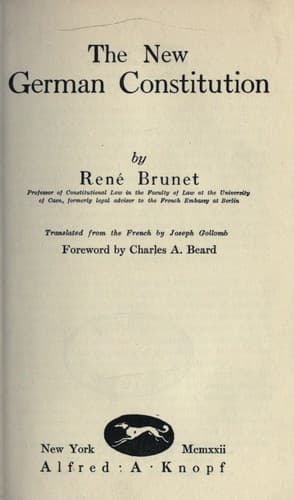
Germany -- Politics and government -- 1918-1933; Germany. Verfassung (1919)
Of the members elected 329 were elected directly in the electoral
districts; 44 were elected in the district groups; 51 on the tickets of
the Reich; 42 other members were sent by territories in which plebiscites
had been ordered. These districts had not participated in the elections,
and retained until the new system the representation they had received in
the election for the National Assembly.
It must be noted finally, what could have been foreseen and what was
aimed at by the law, that the number of votes not utilized is extremely
small. The smallest fragment discarded was that of the People’s Party
with 8,851 votes; then came the Independents with 9,872 votes; the Social
Democrats with 11,457 votes, etc.
The cases in which a fragment of more than 30,000 votes became equivalent
to 60,000 and therefore won seats were as follows: Democrats, German
Nationals, Christian Federalists.
3.--DIRECT GOVERNMENT.
Universal suffrage is the means by which the sovereign people manifests
its will in a democracy. Once the election is over it leaves to the
representatives it has elected the freedom of directing in its name the
affairs of the state. This is the system of representative government. At
the same time the people give their representatives only limited powers,
and they reserve the right themselves to decide on certain particularly
important affairs. In such a case there is direct government. This system
constitutes obviously an immediate application of the democratic idea;
and it may be said that that Constitution is most democratic which avails
itself most of direct government.
The National Assembly has admitted without any difficulty the principle
of direct government into the Constitution. According to the expression
of Preuss, direct government to-day is a “postulate of democracy”; to
this the Social Democrat Quarck has added that direct government is “an
essential element of democracy for which to-day there have been found
positive, practical, and scientific forms, according to established
principles of public law.”[30]
But in this form of government there is found not only a logical
consequence of the principle of national sovereignty; there are also in
it certain considerable advantages.
Public-domain text, read in full here on John Shaqi.
Reviews
Reviews
No reviews yet
Be the first to share your thoughts on this work.
Elsewhere in the archive
Join the Discussion
Join the discussion
Sign in to leave a comment or review.
Sign InorCreate an account