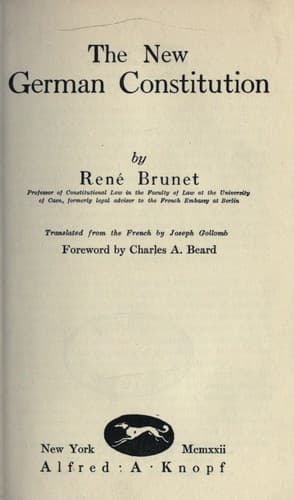
Germany -- Politics and government -- 1918-1933; Germany. Verfassung (1919)
First, there is the educational value in the fact that the people
participate directly in the conduct of public affairs. It is true it
sometimes happens, in countries which have already applied this form
of government that a decision of the people, far from constituting
progress, actually marks if not retrogression, at least an arrest in the
development of social legislation, or even in some matter of general
policy. Nevertheless the very efforts that are made to convince the
people and to bring them back to primary considerations, constitutes the
best kind of civic teaching and gives them a political experience, the
value of which in a democracy cannot be exaggerated. The collaboration
of great strata of the population in the creation of laws and in
political life profoundly educates the masses in the principles of their
Constitution; and an institution which has been established in a country
after bitter struggles, perhaps after several defeats, becomes thereafter
almost impregnable, or cannot be discarded except with extreme difficulty.
In addition direct government constitutes the best system of democratic
control over the organs of the state. Care must be taken in a democracy
to institute control over control; for democratic government is
essentially the reign of trust. The destinies of a nation should not,
therefore, depend exclusively on the parliament. While one may be for
parliamentary government, one may still fear that a powerful majority
may establish a veritable dictatorship and oppress minorities; or that
a majority formed by chance combinations may show itself incapable of
action and retard indefinitely the adoptions of measures impatiently
awaited by the people.
There is, then, place in Germany for direct government; but to what
extent? At first this place seems quite limited. Preuss, who in his
draft of the Constitution made only limited use of it, presented direct
government as convenient above all for small states; but he doubted that
one could apply it in any considerable number of ways in a big country
like Germany. In spite of this opinion direct government gained ground
little by little and in the final text occupies considerable place. One
finds in the Constitution not only the classic forms of constitutional
and legislative initiative and referendum such as, for example, have been
traditionally employed in Swiss and American democracies; but also we
find there new applications of direct government.
Public-domain text, read in full here on John Shaqi.
Reviews
Reviews
No reviews yet
Be the first to share your thoughts on this work.
Elsewhere in the archive
Join the Discussion
Join the discussion
Sign in to leave a comment or review.
Sign InorCreate an account