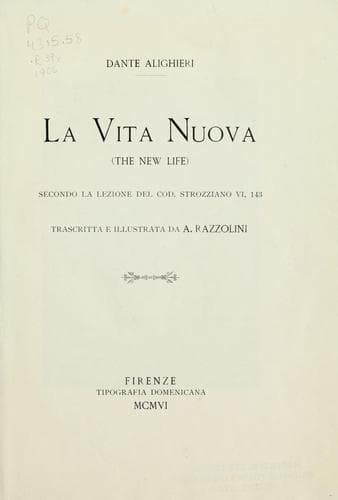
Some few years after producing his translation of the _Vita Nuova_,
Rossetti was desirous of publishing it, and of illustrating the volume
with etchings from various designs, which he had meanwhile done, of
incidents in the story. This project, however, had to be laid aside,
owing to want of means, and the etchings were never undertaken. It was
only in 1861 that the volume named _The Early Italian Poets_, including
the translated _Vita Nuova_, was brought out: the same volume, with
a change in the arrangement of its contents, was reissued in 1874,
entitled _Dante and his Circle_. This book, in its original form, was
received with favour, and settled the claim of Rossetti to rank as a
poetic translator, or indeed as a poet in his own right.
For _The Early Italian Poets_ he wrote a Preface, from which a passage,
immediately relating to the _Vita Nuova_, is extracted in the present
edition. There are some other passages, affecting the whole of the
translations in that volume, which deserve to be borne in mind, as
showing the spirit in which he undertook the translating work, and I
give them here:—
“The life-blood of rhythmical translation is this commandment—that a
good poem shall not be turned into a bad one. The only true motive for
putting poetry into a fresh language must be to endow a fresh nation,
as far as possible, with one more possession of beauty. Poetry not
being an exact science, literality of rendering is altogether secondary
to this chief law. I say _literality_,—not fidelity, which is by no
means the same thing. When literality can be combined with what is thus
the primary condition of success, the translator is fortunate, and must
strive his utmost to unite them; when such object can only be obtained
by paraphrase, that is his only path. Any merit possessed by these
translations is derived from an effort to follow this principle.... The
task of the translator (and with all humility be it spoken) is one of
some self-denial. Often would he avail himself of any special grace of
his own idiom and epoch, if only his will belonged to him: often would
some cadence serve him but for his author’s structure—some structure
but for his author’s cadence: often the beautiful turn of a stanza must
be weakened to adopt some rhyme which will tally, and he sees the poet
revelling in abundance of language where himself is scantily supplied.
Now he would slight the matter for the music, and now the music for the
matter; but no, he must deal to each alike. Sometimes too a flaw in the
work galls him, and he would fain remove it, doing for the poet that
which his age denied him; but no, it is not in the bond.”
Public-domain text, read in full here on John Shaqi.
Reviews
Reviews
No reviews yet
Be the first to share your thoughts on this work.
Join the Discussion
Join the discussion
Sign in to leave a comment or review.
Sign InorCreate an account