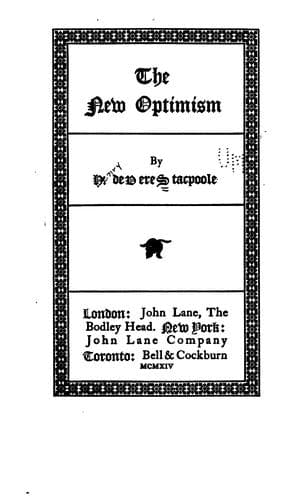
The New OptimismStacpoole, H. De Vere (Henry De Vere)
Philosophy
The New Optimism
Stacpoole, H. De Vere (Henry De Vere)
Evolution; Faith; Social problems; Stacpoole, H. De Vere (Henry De Vere), 1863-1951 -- Philosophy
“What I have said to you about Socialism is not an _ex-parte_ statement
by a man opposed to Socialism. I am opposed to nothing but error, and
when I see Laws as fixed and as immutable as Bode’s Law or the law of
gravity disregarded by men who are proposing to reform the world, and
when I point out these fatal flaws in their reasoning, that does not
mean that I am opposed to all plans for reforming the world, but it
does mean that I would test by everyday logic any plan for everyday use.
“Will it work? Will it perform the work for which it was invented as a
kinetic engine?
“Those are the two questions on which the capitalist satisfies himself
first before he invests his money in any invention in mechanics.
“Then he asks, will it wear without undue destruction of parts?
“Then he satisfies himself as to its economics. Any plan of world
reform which leaves out the Human Equation is equivalent to an
engineering plan which leaves out of consideration details like the Law
of the Dead Centre or the Law of Expansion and contraction of metals.
“If you will examine any great engineering plan, whether it be the plan
for a bridge or a marine engine, you will find that it is a simple
bouquet of natural laws, all brought together by the engineer for a
definite purpose, and every law is stamped with the + or - stamp of
nature. They are the laws of weakness and the laws of strength, and
these wonderful laws that preside over matter so interpenetrate one
another that you cannot divorce them one from the other. They may be
said to form alloys. Thus the law that rules over the breaking strain
is at once the law of strength and weakness. The giant that lives in
water springs into steam under the conditions of the + law that gives
him strength, but never for a moment does he escape from the - law of
condensation which is ever ready to reduce him to water again in a
twinkling. And so on.
“Now, the task of the engineer is _not_ to eliminate the - laws from
nature, but to account for them, and, if possible, to make them, by a
trick of genius, work for him. The engineer does not attempt to destroy
Inertia, the weakness that lives in the dead centre of things; he
counteracts the idleness of inertia by means of the fly-wheel.
“The weakness of Steam under the law of condensation becomes in
the hands of the engineer the strength of the steam-engine. The
bursting power of steam, which is ever at war with the weakness of
the boiler metal, he counteracts by the safety-valve. He must allow
for everything, or his machine either will not work or bursts into a
thousand fragments.
Public-domain text, read in full here on John Shaqi.
Reviews
Reviews
No reviews yet
Be the first to share your thoughts on this work.
Join the Discussion
Join the discussion
Sign in to leave a comment or review.
Sign InorCreate an account