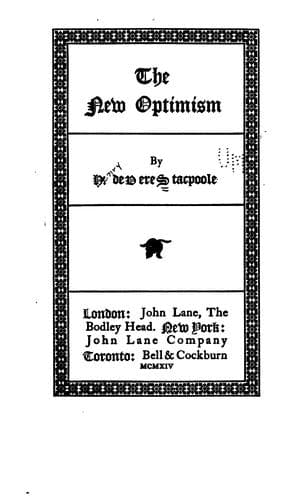
The New OptimismStacpoole, H. De Vere (Henry De Vere)
Philosophy
The New Optimism
Stacpoole, H. De Vere (Henry De Vere)
Evolution; Faith; Social problems; Stacpoole, H. De Vere (Henry De Vere), 1863-1951 -- Philosophy
And it is just as impossible for the impartial and critical observer
to detect a “wise providence” in the fate of individual human beings
as a moral order in the history of peoples. Both are determined with
iron necessity by a mechanical causality which connects every single
phenomenon with one or more antecedent causes. Even the ancient Greeks
recognised _ananke_, the blind _heimarmene_, the fate “that rules
gods and men,” as the supreme principle of the universe. Christianity
replaced it by a conscious Providence, which is not blind, but sees,
and which governs the world in patriarchal fashion. The anthropomorphic
character of this notion, generally closely connected with belief in
a personal God, is quite obvious. Belief in a “loving Father,” who
unceasingly guides the destinies of 1,500,000,000 men on our planet,
and is attentive at all times to their millions of contradictory
prayers and pious wishes, is absolutely impossible; that is at once
perceived on laying aside the coloured spectacles of “faith” and
reflecting rationally on the subject.
As a rule, this belief in Providence and the tutelage of a “loving
Father” is more intense in the modern civilised man—just as in the
uncultured savage—when some good fortune has befallen him: an escape
from peril of life, recovery from a severe illness, the winning of the
first prize in a lottery, the birth of a long-delayed child, and so
forth. When, on the other hand, a misfortune is met with, or an ardent
wish is not fulfilled, “Providence” is forgotten. The wise ruler of the
world slumbered—or refused his blessing.
In the extraordinary development of commerce in the nineteenth century
the number of catastrophes and accidents has necessarily increased
beyond all imagination; of that the journal is a daily witness.
Thousands are killed every year by shipwreck, railway accidents, mine
accidents, etc. Thousands slay one another every year in war, and the
preparation for this wholesale massacre absorbs much the greater part
of the revenue in the highest civilised nations, the chief professors
of “Christian charity.” And among these hundreds of thousands of annual
victims of modern civilisation strong, industrious, courageous workers
predominate. Yet the talk of a “moral order” goes on.
Since impartial study of the evolution of the world teaches us that
there are no definite aim and no special purpose to be traced in it,
there seems to be no alternative but to leave everything to “blind
chance.” This reproach has been made to the transformism of Lamarck and
Darwin, as it has been to the previous systems of Kant and Laplace;
there are a number of dualist philosophers who lay great stress on it.
It is, therefore, worth while to make a brief remark upon it.
Public-domain text, read in full here on John Shaqi.
Reviews
Reviews
No reviews yet
Be the first to share your thoughts on this work.
Join the Discussion
Join the discussion
Sign in to leave a comment or review.
Sign InorCreate an account