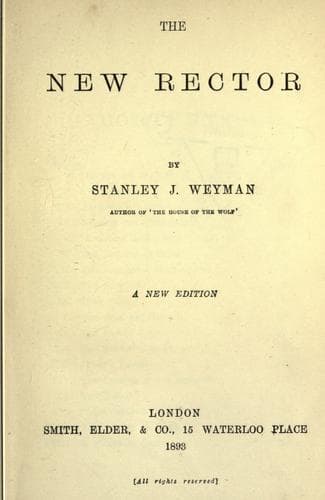
Clergy -- England -- Fiction; England -- Social life and customs -- 19th century -- Fiction
“Never you mind, young lady!” Mr. Bonamy retorted with good-humored
sharpness. “It is true. What is more, I am informed that Lord Dynmore
has evidence that Mr. Lindo has been paying a man, who was aware of
this, a certain sum every week to keep his mouth shut.”
“My goody!” cried Daintry again. “I wonder, now, what he paid him! What
do you think, Jack?” And she turned to Jack to learn what he was doing
that he did not speak.
Poor Jack! Why did he not speak? Why did he stand silent, gazing hard
into the fire? Because he resented his friend’s coldness? Because he
would not defend him? Because he thought him guilty? No, but because in
the first moment of Mr. Bonamy’s disclosure he had looked into Kate’s
face—his cousin’s face, who the moment before had been laughing over
the cards at his side, in all things so near to him—and he had read in
it, with the keen insight, the painful sympathy which love imparts, her
secret. Poor Kate! No one else had seen her face fall or discovered her
embarrassment. A few seconds later even her countenance had regained
its ordinary calm composure, even the blood had gone back to her heart.
But Jack had seen and read aright. He knew, and she knew that he knew.
When at last—but not before Mr. Bonamy’s attention had been drawn to
his silence—he turned and spoke, she avoided his eyes. “That is rather
a wild tale, sir, is it not?” he said with an effort and a pale smile.
If Mr. Bonamy had not been a man of great shrewdness, he would have
been tempted to think that Jack had been in the secret all the time. As
it was, he only answered, “I have reason to think that there is
something in it, wild as it sounds. At any rate, the man in question
has himself told the story to Lord Dynmore.”
“The pensioner?”
“Precisely.”
“Well, I should like to ask him a few questions,” Jack answered
drearily. But for the chill feeling at his heart, but for the knowledge
he had just gained, he would have treated the matter very differently.
He would have thought of his friend only—his feelings, his possible
misery. He would not have condescended in this first moment to the
evidence. But he could not feel for his friend. He could not even pity
him. He needed all his pity for himself.
“I do not answer for the story,” Mr. Bonamy continued. “But there is no
doubt of one thing—that Mr. Lindo was appointed in error, whether he
was aware of the mistake or not. I do not know,” the lawyer added
thoughtfully, “that I shall pity him greatly. He has been very
mischievous here. And he has held his head very high.”
“He is the more likely to suffer now,” Jack answered almost cynically.
“Possibly,” the lawyer replied. Then he added, “Daintry, fetch me my
slippers, there is a good girl. Or, stay. Get me a candle and take them
to my room.”
Public-domain text, read in full here on John Shaqi.
Reviews
Reviews
No reviews yet
Be the first to share your thoughts on this work.
Elsewhere in the archive
Join the Discussion
Join the discussion
Sign in to leave a comment or review.
Sign InorCreate an account