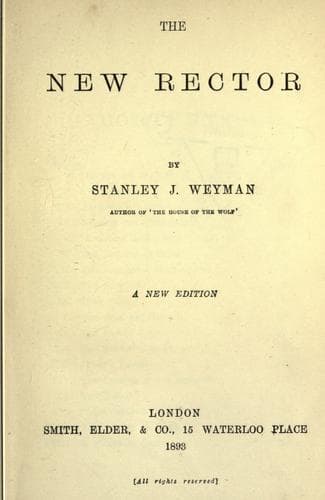
Clergy -- England -- Fiction; England -- Social life and customs -- 19th century -- Fiction
He went out after her, leaving the cousins alone. Neither spoke. Jack
stood near the corner of the mantel-shelf, gazing rigidly, almost
sullenly, into the fire. What was Lindo to him? Why should he be sorry
for him? A far worse thing had befallen himself. He tried to harden his
heart, and to resolve that nothing of his suffering should be visible
even to her. But he had scarcely formed the resolution when, his eyes
wandering despite his will to the pale set face on the other side of
the hearth, he sprang forward and, almost kneeling, took her hand in
both his own. “Kate,” he whispered, “is it so? Is there no hope for me,
then?”
She, too, had been looking into the fire. She could feel for him now.
She no longer thought his attentions “nonsense” as at the station a
while back. But she could not speak. She could only shake her head, the
tears in her eyes.
Jack laid down the hand and rose and went back to the fire, and stood
looking into it sorrowfully; but his thoughts were no longer wholly of
himself. Brave heart, the rarest of gentlemen, though he was neither
six feet high nor an Adonis, he had scarcely felt the weight of the
blow which had fallen on himself, before he began to think what he
could do to help her. Presently he put his thought into words. “Kate,”
he said, in a voice scarcely above a whisper, “can I do anything?”
She had made no attempt to deny the inference he had drawn. She seemed
content, indeed, that he should have her secret, though the knowledge
of it by another would have covered her with shame. But at the sound of
his question she only shook her head with a sorrowful smile.
It was all dark to him. He knew nothing of the past—only that the faint
suspicion he had felt at the bazaar was justified, and that Kate had
given away her heart. He did not dare to ask whether there was any
understanding between her and his friend; and, not knowing that, what
could he do? Nothing, he was afraid.
Then a noble thought came into his head. “I am afraid,” he said slowly,
looking at his watch, “that Lindo is in great trouble. I think I will
go to him. It is not ten o’clock.”
He tried not to look at her as he spoke, but all the same he saw the
crimson tide rise slowly over cheek and brow, which his prayer had left
so pure and pale. Her lip trembled and she rose hurriedly, muttering
something inaudible. Poor Jack!
For a moment self got the upper hand, and he stood still, frowning.
Then he said gallantly, “Yes, I think I will go. Will you let my uncle
know in case I should be late.”
He did not look at her again, but hurried out of the room. It was a
stiff, formal room, we know—a set, comfortless, middle-class room,
which had given the rector quite a shock on his first introduction to
it—but if it had grafted all the grace of the halls of Abencerrages
upon the stately comfort of a sixteenth-century dining-hall it would
have been no more than worthy of the man who quitted it.
CHAPTER XVIII.
A FRIEND IN NEED.
Public-domain text, read in full here on John Shaqi.
Reviews
Reviews
No reviews yet
Be the first to share your thoughts on this work.
Elsewhere in the archive
Join the Discussion
Join the discussion
Sign in to leave a comment or review.
Sign InorCreate an account