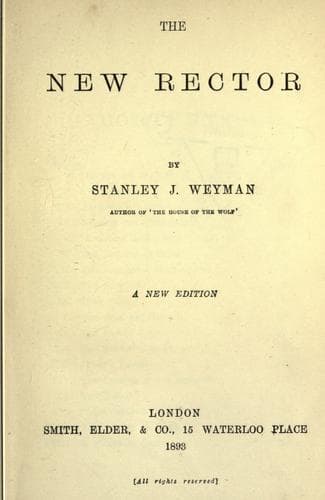
Clergy -- England -- Fiction; England -- Social life and customs -- 19th century -- Fiction
“He had need to be,” Jack snorted. “It sounds an extraordinary story.
All the same, Lindo, I am not sure it has any connection with this.” He
held the letter up before him as though drawing inspiration from it.
“This letter, you see,” he went on presently, “being the first in date
would be inside the packet. Why should a man who wanted perhaps a bit
of paper for a spill or a pipe-light unfasten this packet and take the
innermost letter? I do not believe it.”
“But no one else save myself,” Lindo urged, “has had access to the
letter. And there it is torn.”
“Yes, here it is torn,” Jack admitted, gazing thoughtfully at it; “that
is true.”
For a few moments the two sat silent, Jack fingering the letter, Lindo
with his eyes fixed gloomily on the fire. Suddenly the rector broke out
without warning or preface. “What a fool I have been!” he exclaimed,
his tone one of abrupt overwhelming conviction. “Good heavens, what a
fool I have been!”
His friend looked at him in surprise, and saw that his face was
crimson. “Is it about the letter?” he asked, leaning forward, his tone
sharp with professional impatience. “You do not mean to say, Lindo,
that you really——”
“No, no!” replied the young clergyman, ruthlessly interrupting him. “It
has nothing to do with the letter.”
He said no more, and Jack waited for further light, but none came, and
the barrister reapplied his thoughts to the problem before him. He had
only just hit upon a new idea, however, when he was again diverted by
an interruption from Lindo. “Jack,” said the latter impressively, “I
want you to give a message for me.”
“Not a cartel to Lord Dynmore, I hope?” the barrister muttered.
“No,” Lindo answered, getting up and poking the fire unnecessarily—what
a quantity of embarrassment has been liberated before now by means of
pokers—“no, I want you to give a message to your cousin—Miss Bonamy, I
mean.” The rector paused, the poker still in his hand, and stole a
sharp glance at his companion; but, reassured by the discovery that he
was to all appearance buried in the letter, he continued: “Would you
mind telling her that I am sorry I misjudged her a short time back—she
will understand—and behaved, I feel, very ungratefully to her? She
warned me that there was a rumor afloat that something was amiss with
my title, and I am afraid I was very rude to her. I should like you to
tell her, if you will, that I—that I am particularly ashamed of
myself,” he added, with a gulp.
Public-domain text, read in full here on John Shaqi.
Reviews
Reviews
No reviews yet
Be the first to share your thoughts on this work.
Elsewhere in the archive
Join the Discussion
Join the discussion
Sign in to leave a comment or review.
Sign InorCreate an account