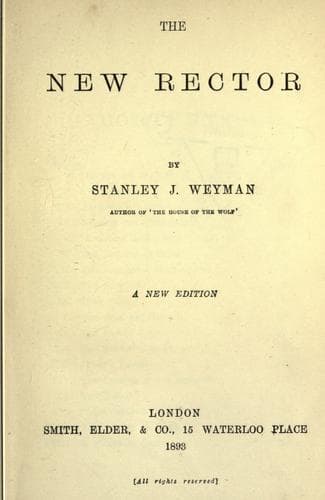
Clergy -- England -- Fiction; England -- Social life and customs -- 19th century -- Fiction
He did not find the words easy of utterance—far from it; but the effort
they cost him was slight and trivial compared with that which poor Jack
found himself called upon to make. For a moment, indeed, he was silent,
his heart rebelling against the task assigned to him. To carry his
message to her! Then his nobler self answered to the call, and he
spoke. His words, “Yes, I’ll tell her,” came, it is true, a little
late, in a voice a trifle thick, and were uttered with a coldness which
Lindo would have remarked had he not been agitated himself. But they
came—at a price. The Victoria Cross for moral courage can seldom be
gained by a single act of valor. Many a one has failed to gain it who
had strength enough for the first blow. “Yes, I will tell her,” Jack
repeated a few seconds later, folding up the letter and laying it on
the table, but so contriving that his face was hidden from his friend.
“To-morrow will do, I suppose?” he added, the faintest tinge of irony
in his tone. He may be pardoned if he thought the apology he was asked
to carry came a little late.
“Oh, yes, to-morrow will do,” Lindo answered with a start; he had
fallen into a reverie, but now roused himself. “I am afraid you are
very tired, old fellow,” he continued, looking gratefully at his
friend. “A friend in need is a friend indeed, you know. I cannot tell
you”—with a sigh—“how very good I think it was of you to come to me.”
“Nonsense!” Jack said briskly. “It was all in the day’s work. As it is,
I have done nothing. And that reminds me,” he continued, facing his
companion with a smile—“what of the trouble between my uncle and you?
About the sheep, I mean. You have put it in some lawyer’s hands, have
you not?”
“Yes,” Lindo answered reluctantly.
“Quite right, too,” said the barrister. “Who are they?”
“Turner & Grey, of Birmingham.”
“Well, I will write,” Jack answered, “if you will let me, and tell them
to let the matter stand for the present. I think that will be the best
course. Bonamy won’t object.”
“But he has issued a writ,” the rector explained. A writ seemed to him
a formidable engine. As well dally before the mouth of a cannon.
But Jack knew better. The law’s delays were familiar to him. He was
aware of many a pleasant little halting-place between writ and
judgment. “Never mind about that,” he answered, with a confident laugh.
“Shall I settle it for you? I shall know better, perhaps, what to say
to them.”
The rector assented gladly; adding: “Here is their address.” It was
stuck in the corner of a picture hanging over the fireplace. He took it
down as he spoke and gave it to Jack, who put it carelessly into his
pocket, and, seizing his hat, said he must go at once—that it was close
on twelve. The rector would have repeated his thanks; but Jack would
not stop to hear them, and in a moment was gone.
Public-domain text, read in full here on John Shaqi.
Reviews
Reviews
No reviews yet
Be the first to share your thoughts on this work.
Elsewhere in the archive
Join the Discussion
Join the discussion
Sign in to leave a comment or review.
Sign InorCreate an account