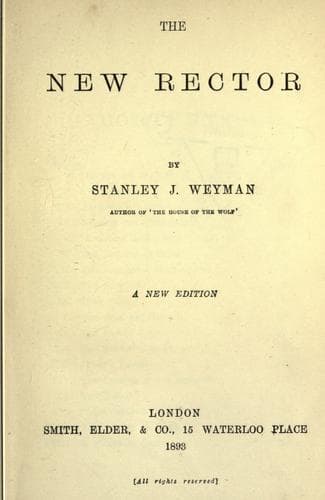
Clergy -- England -- Fiction; England -- Social life and customs -- 19th century -- Fiction
Dr. Gregg went away calling the lawyer a bear and an ill-bred fellow
who did not know his own friends. Alas! the same thing might have been
said, and with greater justice, of the rector. The archdeacon sat an
hour in his study, waiting patiently for him to return from his
district, and after all got but a sorry reception. The elder man
expressed, and expressed very warmly—he had come to do so—his full
belief in Lindo’s honesty and good faith, and was greatly touched by
the effect his words produced upon the young fellow, who had come into
the room, after learning his visitor’s presence, with set lips and eyes
of challenge, but had by-and-by to turn his back on his friend and look
out of the window, while in a very low tone he murmured his thanks.
But, alas! the archdeacon went farther, and let drop something about
concession, and then the boat was over!
“Concession!” said the young man, turning as on a pivot, with every
hair of his whiskers bristling, and his voice clear enough now. “What
kind of concession do you mean?”
“Well,” said the archdeacon persuasively, “the earl is a choleric man—a
most passionate man, I know; and, when excited, utterly foolish and
wrong-headed. But in his cooler moments I do not know any one more just
or, indeed, more generous. And I feel sure that if you could prevail on
yourself to meet him half-way——”
“By resigning?” snapped the rector, interrupting him point-blank with
the question.
“Oh, no, no,” said the archdeacon, “I do not mean that.”
“Then in what way? How?”
But as the archdeacon really meant by resigning, he could not answer
the question, and the interview ended in Lindo roundly declaring, as he
walked up and down the room, “I will not resign! Understand that,
archdeacon! I will not resign! If Lord Dynmore can put me out, well and
good—let him. If not, I stay. He may be just or generous,” continued
the young man scornfully—“all I know is that he insulted me grossly,
and as no gentleman would have insulted another.”
“He is passionate, and was taken by surprise,” the archdeacon ventured
to say. But Lindo would not listen; and his visitor had presently to
go, fearing that he had done more harm than good by his mediation. As
for the rector, he was severely scolded later in the evening by Jack
Smith for having omitted to lay the letters offering him the living
before the archdeacon, or to explain to him the precise circumstances
under which he had accepted it.
“But he said he did not doubt me,” the rector urged rather fractiously.
“Pooh! that is not the point,” the barrister retorted. “Of course he
does not. He knows you. But I want to put him in possession of such a
case as he may lay before others who do not know you. Look here, you
are acquainted with a man called Felton, are you not?”
“Yes,” Lindo answered, with a slight start.
Public-domain text, read in full here on John Shaqi.
Reviews
Reviews
No reviews yet
Be the first to share your thoughts on this work.
Elsewhere in the archive
Join the Discussion
Join the discussion
Sign in to leave a comment or review.
Sign InorCreate an account