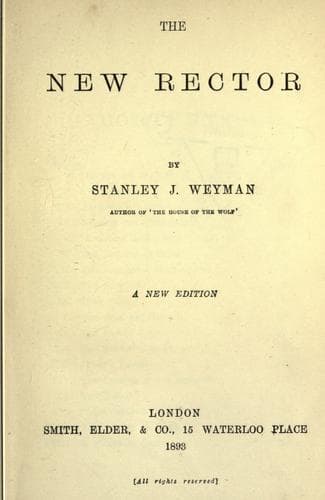
Clergy -- England -- Fiction; England -- Social life and customs -- 19th century -- Fiction
“Well, perhaps you are not aware that he has been to Lord Dynmore—so
the tale runs in the town, and I know it is true—and stated that you
have been for weeks bribing him to keep the secret.”
The rector sat motionless, staring at his friend. “I did not know it,”
he said at last, quite quietly. He was becoming accustomed to surprises
of this kind. “It is a wicked lie, of course.”
“Of course,” Jack assented tossing one leg easily over the other, and
thrusting his hands deep into his trousers’ pockets. “But what do you
say to it?”
“The man came to me,” Lindo answered steadily, “and told me that he was
Lord Dynmore’s servant, and that, crossing from America, he had
foolishly lost his money at play. He begged me to assist him until Lord
Dynmore’s return, and I did so. Some ten days ago I discovered that he
was leading a disreputable life, and I stopped the allowance.”
“Thanks,” said Jack, nodding his head. “That is precisely what I
thought. But the mischief of it is, you see, that the man’s tale may be
true in his eyes. He may have believed that he was blackmailing you.
And therefore, since we cannot absolutely refute his story, it is the
more important that we should show as good a case as possible
_aliunde_. Nor does it make any difference,” Jack continued drily,
“that the man, after seeing Lord Dynmore last night, has taken himself
quietly off this morning.”
“What! Felton?” the rector exclaimed, coming suddenly upright.
“Yes. There is no doubt he has absconded. Bonamy’s clerk has been after
him all day, and has discovered that he begged half-a-crown from your
curate, to whom he was seen speaking at the Top of the Town about ten
this morning. Since that time he has not been seen.”
“He may turn up yet,” said the rector.
“I do not think he will,” the barrister replied, with a shrewd gleam in
his eyes. “But you must not flatter yourself that his disappearance
will do you any good. Of course some people will say that he was afraid
to remain and support a false statement. But more, I fear, will lean to
the opinion that he was got out of the way by some one—you, for
instance.”
“I see,” said Lindo slowly, after a long pause. “Then it is the more
imperative that I should not dream of resigning.”
“I think so,” said Jack.
CHAPTER XX.
A SUDDEN CALL.
“Kate,” said Daintry, looking up from a lesson book as her sister
entered the dining-room a few mornings after the bazaar, “are you
_never_ going to see old Peggy Jones again? I am sure that you have not
been near her for a fortnight?”
“I ought to go, I know,” Kate answered, pausing by the sideboard, with
a big bunch of keys dangling from her fingers and an absent expression
in her gray eyes. “I have not been for some time.”
“I should think you had not!” quoth Daintry severely. “You have hardly
been out of the house the last four days.”
Public-domain text, read in full here on John Shaqi.
Reviews
Reviews
No reviews yet
Be the first to share your thoughts on this work.
Elsewhere in the archive
Join the Discussion
Join the discussion
Sign in to leave a comment or review.
Sign InorCreate an account