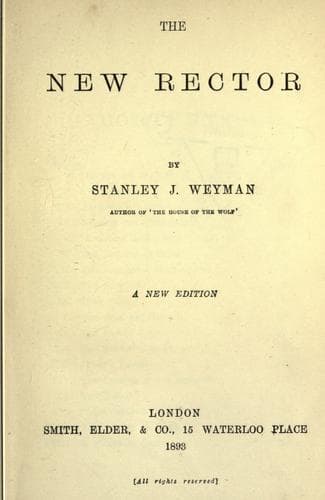
Clergy -- England -- Fiction; England -- Social life and customs -- 19th century -- Fiction
Two women with shawls over their heads came to the side of the gig. “Be
you the doctors?” said one of them; and then in another minute the two
were following her up the side of the cutting which here confined the
road. The hillside gained, they were hurried round pit-banks and
slag-heaps, and under cranes and ruinous sinking walls, and over and
under mysterious obstacles, sometimes looming large in the gloom and
sometimes lying unseen at their feet—until they emerged at length with
startling abruptness into a large circle of dazzling light. Four great
fires were burning close together, and round them, motionless and for
the most part silent, in appearance almost apathetic, stood hundreds of
dark shadows—men and women waiting for news.
The silence and inaction of so large a crowd struck a chill to Lindo’s
heart. When he recovered himself, he was standing in the midst of a
dozen rough fellows, some half-stripped, some muffled up in
pilot-jackets or coarse shiny clothes. The crowd seemed to be watching
them, and they spoke now and then to one another in a desultory
expectant fashion, from which he judged they were in authority.
“It is a bad job—a very bad job!” his companion was saying nervously.
“Is there anything I can do yet?”
“Well, that depends, doctor,” answered one of the men, his manner of
speaking proving that he was not a mere working collier. “There is no
one up yet,” he added, eyeing the doctor dubiously. “But it does not
exactly follow that you can do nothing. Some of us have just come up,
and there is a shift of men exploring down there now. Three bodies have
been recovered, and they are at the foot of the shaft; and three poor
fellows have been found alive, of whom one has since died. The other
two are within fifty yards of the shaft, and as comfortable as we can
make them. But they are bad—too bad to come up in a bucket; and we can
rig up nothing bigger at present so there they are fixed. The question
is, will you go down to them?”
Mr. Keogh’s face fell, and he shook his head. He was no longer young,
and to descend a sheer depth of five hundred yards in a bucket dangling
at the end of a makeshift rope was not in his line. “No, thank you,” he
said, “I could not do it.”
“Come, doctor,” the man persisted—he was the manager of a neighboring
colliery—“you will be there in no time.”
“Just so,” said the surgeon drily. “It is the coming back is the rub,
you see, Mr. Peat. No, thank you, I could not.”
The other still urged him. “These poor fellows are about as bad as they
can be, and you know if the mountain will not go to Mahomet, Mahomet
must go to the mountain.”
“I know; and if it were a mountain, well and good,” Mr. Keogh answered,
smiling in sickly fashion as his eye strayed to a black well-like hole
close at hand—a mere hole in some loose planks surmounted by a windlass
and fringed with ugly wreckage. “But it is not. It is quite the other
thing, you see.”
Public-domain text, read in full here on John Shaqi.
Reviews
Reviews
No reviews yet
Be the first to share your thoughts on this work.
Elsewhere in the archive
Join the Discussion
Join the discussion
Sign in to leave a comment or review.
Sign InorCreate an account