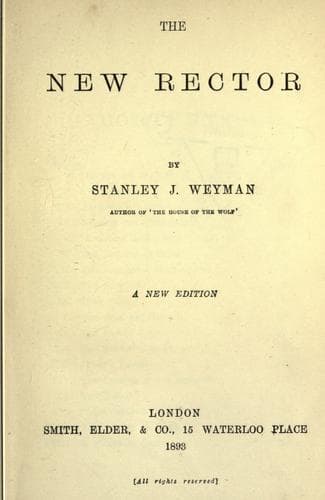
Clergy -- England -- Fiction; England -- Social life and customs -- 19th century -- Fiction
“It is, but the view I take of it is different,” the young clergyman
answered earnestly. “Let me explain, Jack. When I agreed with you a few
days ago that the proper course for me to follow, the course which
would most fitly assert my honesty and good faith, was to retain the
living in spite of threats and opposition, I had my own interests and
my own dignity chiefly in view. I looked upon the question as one
solely between Lord Dynmore and myself; and I felt, rightly as I still
think, that, as a man falsely accused by another man, I had a right to
repel the charge by the only practical means in my power—by maintaining
my position and defying him to do his worst.”
He paused.
“Well,” said Jack drily.
But the rector did not continue at once, and when he did speak it was
with evident effort. He first went back to the fire, and stood gazing
into it in the old attitude, with his head slightly bowed and his foot
on the fender. The posture was one of humility, and so unlike the man,
that it struck Jack and touched him strangely. At last Lindo did
continue. “Well,” he said slowly, “that was all right as far as it
went. My mistake lay in taking too narrow a view. I thought only of
myself and Lord Dynmore, when I should have been thinking of the parish
and of—a word I know you are not very fond of—the Church. I should have
remembered that with this accusation hanging over me I could not hope
to do much good among my people; and that to many of them I should seem
an interloper, a man clinging obstinately to something not his own nor
fairly acquired. In a word, I ought to have remembered that for the
future I should be useless for good and might, on the other hand,
become a stumbling-block and occasion for scandal—both inside the
parish and outside. You see what I mean, I am sure.”
“I see,” quoth Jack contemptuously, “that you need a great many words
to make out your case. What I do not think you have considered is the
inference which will be drawn from your resignation—you will be taken
to have confessed yourself in the wrong.”
“I cannot help that.”
“Will not that be a scandal?”
“It will, at any rate, be one soon forgotten.”
“Now, I tell you what!” Jack exclaimed, standing still and confronting
the other with the air of a man bent on speaking his mind though the
heavens should fall. “This is just a piece of absurd Quixotism, Lindo.
You are a poor man, without means and without influence; and you are
going, for the sake of a foolish idea—a mere speculative scruple—to
give up an income and a house and a useful sphere of work such as you
will never get again! You are going to do that, and go back—to what? To
a miserable curacy—don’t wince, my friend, for that is what you are
going to do—and an income one-fifth of that which you have been
spending for the last six months! Now the sole question is, are you
quite an idiot?”
“You are pretty plain-spoken,” said the rector, smiling feebly.
Public-domain text, read in full here on John Shaqi.
Reviews
Reviews
No reviews yet
Be the first to share your thoughts on this work.
Elsewhere in the archive
Join the Discussion
Join the discussion
Sign in to leave a comment or review.
Sign InorCreate an account