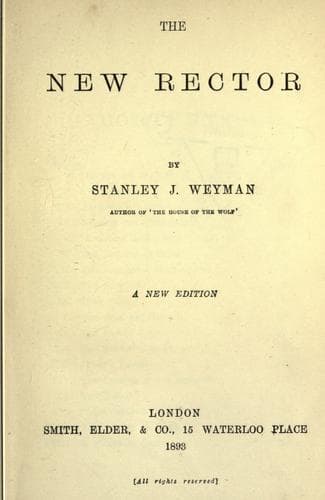
Clergy -- England -- Fiction; England -- Social life and customs -- 19th century -- Fiction
“I mean to be!” was Jack’s uncompromising retort. “I have asked you,
and I want an answer—are you a fool?”
“I hope not.”
“Then you will give up this fool’s notion?” Jack replied viciously.
But the rector’s only answer was a shake of the head. He did not look
round. Had he done so, he would have seen that, though Jack’s keen face
was flushed with anger and annoyance, his eyes were moist and wore an
expression at variance with his tone.
He missed that, however; and Jack made one more attempt. “Look here,”
he said bluntly; “have you considered that if you stop you will find
your path a good deal smoothed by last night’s work?”
“No, I have not,” the rector answered stubbornly.
“Well, you will find it so, you may be sure of that! Why, man alive!”
Jack continued with vehemence, “you are going to be the hero of the
place for the time. No one will believe anything against you, except,
perhaps, Gregg and a few beasts of his kind. Whereas, if you go now, do
you know who will get your berth?”
“No.”
Jack rapped out the name. “Clode! Clode, and no one else, I will be
bound!” he said. “And you do not love him.”
The rector had not expected the reply. He started, and, removing his
foot from the fender, turned sharply so as to face his friend. “No,” he
said slowly, “I do not think I do like him. I consider that he has
behaved badly, Jack. He has not stood by me as he should have done, or
as I would have stood by him had our positions been reversed. I do not
think he has called here once since the bazaar, except on business, and
then I was out. I had planned, indeed, to see him to-day and ask him
what it meant, and, if I found he had come to an adverse opinion in my
matter, to give him notice. But now——”
“You will make him a present of the living instead,” Jack said grimly.
“I do not know why he should get it,” the rector answered, with a
frown, “more than any one else.”
“It is the common report that he will,” Jack retorted. “As for that,
however——”
But why follow him through all the resources of his art? He put forth
every effort—perhaps against his own better judgment, for a man will do
for his friend what he will not do for himself—to persuade the rector
to recall his decision. And he failed. He succeeded, indeed, in
wringing the young clergyman’s heart and making him wince at the
thought of his barren future and his curate’s triumph; but there his
success ended. He made no progress toward inducing him to change his
mind; and presently he found that all the arguments he advanced were
met by a set formula, to which the rector seemed to cling as in
self-defence.
“It is no good, Jack,” he answered—and if he said it once, he said it
half a dozen times—“it is no good! I cannot take any one’s advice on
this subject. The responsibility is mine, and I cannot shift it! I must
try to do right according to my own conscience!”
Public-domain text, read in full here on John Shaqi.
Reviews
Reviews
No reviews yet
Be the first to share your thoughts on this work.
Elsewhere in the archive
Join the Discussion
Join the discussion
Sign in to leave a comment or review.
Sign InorCreate an account