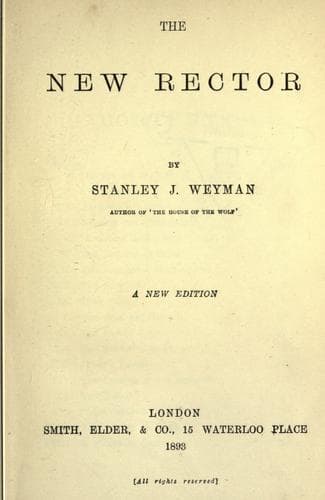
Clergy -- England -- Fiction; England -- Social life and customs -- 19th century -- Fiction
“No,” he said, “I am sure I had not. It was your hint which led me to
think the position out from the beginning. When I did so it struck me
that, irritated by Lord Dynmore’s words and manner, I had considered
the question only as it affected him and myself. Going on to think of
the parish, I came to the conclusion, that I was quite unfit for the
position.”
Kate started. The end of his sentence was a surprise to her. They were
walking along side by side now—very slowly—and she looked at him, mute
interrogation in her eyes.
“I am too young,” he said. “Your father, you know, was of that opinion
from the first.”
“Oh, but”—she answered hurriedly, “I——”
“You do not think so?” he said with a droll glance. “Well, I am glad of
that. What? You were not going to say that, Miss Bonamy?”
“No,” she answered, blushing. “I was going to say that my father’s
opinion might not now be the same, Mr. Lindo.”
“I expect it is. However, the opinion on which I acted was my own. I
have a very hasty temper, do you know. This very afternoon I have been
quarrelling, and have put my foot into it! I confess I thought when I
came here that I could manage. Now I see I am not fit for it—for the
living, I mean.”
“Perhaps,” she answered slowly and in a low voice, “you are the more
fit because you feel unfit.”
“Well, I do not think I dare act on that,” he cried gaily. “So you now
see before you, Miss Bonamy, a very humble personage—a kind of clerical
man-of-all-work out of place! You do not know an incumbent of easy
temper who wants a curate, do you?”
He spoke lightly, without any air of seeking or posing for admiration.
Yet there was a little inflection of bitterness in his voice which did
not escape her ear, and perhaps spoke to it—and to her heart—more
loudly, because it was not intended for either. She suddenly looked at
him, and her face quivered, and then she looked away. But he had seen
and understood. He marked the color rising to the roots of her hair,
and was as sure as if he had seen them that her eyes were wet with
tears.
And then he knew. He felt a sudden answering yearning toward her, a
forgetfulness of all her surroundings, and of all his surroundings save
herself alone. What a fool, what an ingrate, what a senseless clod he
had been, not to have seen months before—when it was in his power to
win her, when he might have asked for something besides her pity, when
he had something to offer her—that she was the fairest, purest, noblest
of women! Now, when it was too late, and he had sacrificed all to a
stupid conventionality, a social prejudice—what was her father to her
save the natural crabbed foil of her grace and beauty—now he felt that
he would give all, only he had nothing to give, to see her wide gray
eyes grow dark with tenderness, and—and love.
Yes, love. That was it. He knew now. “Miss Bonamy,” he said hurriedly.
“Will you——”
Public-domain text, read in full here on John Shaqi.
Reviews
Reviews
No reviews yet
Be the first to share your thoughts on this work.
Elsewhere in the archive
Join the Discussion
Join the discussion
Sign in to leave a comment or review.
Sign InorCreate an account