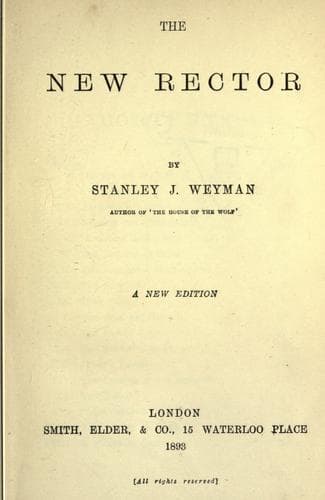
Clergy -- England -- Fiction; England -- Social life and customs -- 19th century -- Fiction
Kate started. “Here is my cousin,” she said quietly, and yet with
suspicious abruptness. “I think he is looking for me, Mr. Lindo.”
CHAPTER XXIV.
THE CUP AT THE LIP.
The ten days which followed the events just described were long
remembered in Claversham with fondness and regret. The accident at
Baerton, and the strange position of affairs at the rectory, falling
out together, created intense excitement in the town. The gossips had
for once as much to talk about as the idlest could wish, and found,
indeed, so much to say on the one side and the other that the grocer,
it was rumored, ordered in a fresh supply of tea, and the two bakers
worked double tides at making crumpets and Sally Lunns, and still
lagged behind the demand. Old Peggy from the almshouse hung about the
churchyard half the day, noting who called at the rector’s, and took as
much interest in her task as if her weekly dole had depended on Mr.
Lindo’s fortunes; while every one who could lay the least claim to
knowing more than his neighbors became for the time the object of as
many attentions as a London belle.
The archdeacon drove in and out daily. Once the rumor got abroad that
he had gone to see Lord Dynmore; and more than once it was said that he
was away at the palace conferring with the bishop. Those most concerned
walked the streets with the faces of sphinxes. The curate and the
rector were known to be on the most distant terms; and to put an edge
on curiosity, already keen, Mrs. Hammond was twice seen talking to Mr.
Bonamy in the street.
Even the poor colliers’ funeral, though a great number of the townsmen
trooped out to the bleak little churchyard on Baer Hill to witness
it—and to be rewarded by the sight of the young rector reading the
service in the midst of a throng of bareheaded pitmen such as no
Claversham eye had ever seen before—even this, which in ordinary times
would have furnished food for talk for a month, at least, went for
little now. It was discussed, indeed, for an evening, and then recalled
only for the sake of the light which it was supposed to throw upon the
rector’s fate.
That gentleman, indeed, continued to present to the public an unmoved
face. But in private, in the seclusion of his study—the lordly room
which he had prized and appreciated from the first, taking its spacious
dignity as the measure of his success—he wore no mask. There he had—as
all men have, the man of destiny and the conscript alike—his solitary
hours of courage and depression, anxiety and resignation. Of hope also;
for even now—let us not paint him greater than he was—he clung to the
possibility that Lord Dynmore, whom every one agreed in describing as
irascible and hasty, but generous at bottom, would refuse to receive
his resignation of the living, and this in such terms as would enable
him to remain without sacrificing his self-respect. There would be a
victory indeed, and at times he could not help dwelling on the thought
of it.
Public-domain text, read in full here on John Shaqi.
Reviews
Reviews
No reviews yet
Be the first to share your thoughts on this work.
Elsewhere in the archive
Join the Discussion
Join the discussion
Sign in to leave a comment or review.
Sign InorCreate an account