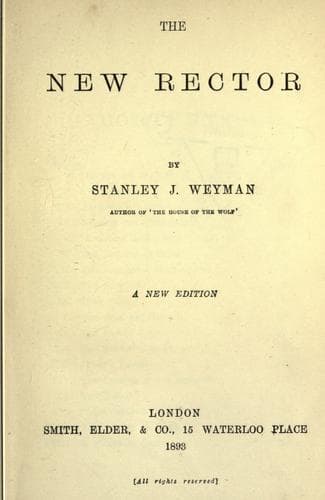
Clergy -- England -- Fiction; England -- Social life and customs -- 19th century -- Fiction
Consequently, when Mrs. Baker, four days after the funeral, ushered in
the archdeacon, and the young rector, turning at his writing-table,
read his fate in the old gentleman’s eyes, the news came upon him with
crushing weight. Yet he did not give way. He rose and welcomed his
visitor with a brave face. “So the bearer of the bow-string has come at
last!” he said lightly, as the two met on the hearth-rug.
The archdeacon held his hand a few seconds longer than was necessary.
“Yes,” he said, “I am afraid that is about what I am. I am sorry to
bring you such news, Lindo—more sorry than I can tell you.” And, having
got so far, he dropped his hat and picked it up again in a great hurry,
and for a moment did not look at his companion.
“After all,” the rector said manfully, “it is the only news I had a
right to expect.”
“There is something in that,” the archdeacon admitted, sitting down.
“That is so, perhaps. All the same,” he went on, looking about him
unhappily, and rubbing his head in ill-concealed irritation, “if I had
known how the earl would take it, I should not have advised you to make
any concessions. No, I should not. But, there, he is an odd man—odder
than I thought.”
“He accepts my offer to resign, of course?”
“Yes.”
“And that is all?” the rector said, a little huskiness in his tone.
“That is all,” the archdeacon replied, rubbing his head again. It was
plain that he had hard work to keep his vexation within bounds.
“Well, I must not complain because he has taken me at my word,” the
rector said, recovering himself a little.
“Well, I hoped the bishop might have had a word to say to it,” the
archdeacon grumbled. “But he had not, and I could not get to see his
wife. He spoke very highly of your conduct, but he did not see his way
clear, he said, to interfering.”
“I scarcely see how he could,” Lindo answered slowly.
“Well, I do not know. Bonamy’s representation in the church-wardens’
names was very strong—very strong indeed, coming from them, you know.”
Lindo reddened. “There is an odd man for you, if you like,” he said
impulsively. He was glad, perhaps, to change the subject. “He has
scarcely said a civil word to me since I came. He even began an action
against me. Yet when this happened he turned round and in his way
fought for me.”
“Well, that is Bonamy all over!” the archdeacon answered, almost with
enthusiasm. “He is rough and crabbed, but he has the instincts of a
gentleman, which are the greater credit to him, since he is a self-made
man. I think I can tell you something about him, though, which you do
not know.”
“Indeed?” said Lindo mechanically.
“Yes. It has to do with your letter, too. I had it from Lord Dynmore.
In the first flush of his anger, it seems, he went to Bonamy and
directed him to take the necessary steps to eject you. He is not the
earl’s solicitor, and he must have seen an excellent opportunity of
getting hold of the Dynmore business through this. He could not but see
it. Nevertheless, he declined.”
Public-domain text, read in full here on John Shaqi.
Reviews
Reviews
No reviews yet
Be the first to share your thoughts on this work.
Elsewhere in the archive
Join the Discussion
Join the discussion
Sign in to leave a comment or review.
Sign InorCreate an account