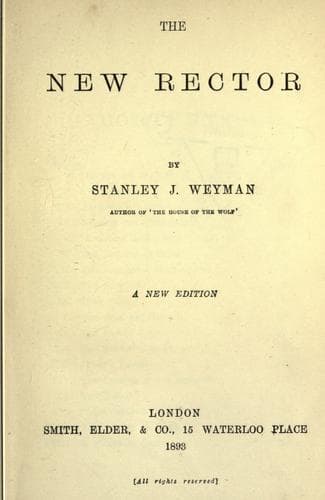
Clergy -- England -- Fiction; England -- Social life and customs -- 19th century -- Fiction
“It has just this to do with it, Mr. Clode,” the lawyer answered drily,
a twinkle in his eyes—“that this address is written on the reverse side
of the very piece of paper which is missing from Mr. Lindo’s letter—the
important letter I have described. And I wish to ask you, and I think
it will be to your interest to give as clear an answer to the question
as possible, how you came into possession of this scrap of paper.”
The curate glared at his questioner. “I do not understand you,” he
stammered. And he held out his hand for the paper.
“I think you will when you look at both sides of the sheet,” replied
the lawyer, handing it to him. “On one side there is the address you
wrote. On the other are the last sentence and signature of a letter
from Messrs. Gearns & Baker to Mr. Lindo. The question is a very simple
one. How did you get possession of this piece of paper?”
Clode was silent—silent, though he knew that the archdeacon was looking
at him, and that a single hearty spontaneous denial might avert
suspicion. He stood holding the paper in his hand, and gazing stupidly
at the damning words, utterly unable to comprehend for the moment how
they came to be there. Little by little, however, as the benumbing
effects of the surprise wore off, his thoughts went back to the evening
when the address was written, and he remembered how the rector had come
in and surprised him, and how he had huddled away the letters. In his
disorder, no doubt, he had left one lying among his own papers, and
made the fatal mistake of tearing from it the scrap on which he had
written the address.
He saw it all as he stood there, still gazing at the piece of paper,
while his rugged face grew darkly red and then again a miserable
sallow, and the perspiration sprang out upon his forehead. He felt that
the archdeacon’s eyes were upon him, that the archdeacon was waiting
for him to speak. He saw the mistake he had made, but his brain,
usually so ready, failed to supply him with the explanation he
required.
“You understand?” Mr. Bonamy said slowly. “The question is, how this
letter came to be in your room that evening, Mr. Clode. That is the
question.”
“I cannot say,” he answered huskily. He was so shaken by the unexpected
nature of the attack, and by the strange and ominous way in which the
evidence against him had arisen, that he had not the courage to look up
and face his accuser. “I think—nay, I am sure, indeed—that the rector
must have given me the paper,” he explained, after an awkward pause.
“He is positive he did not,” Mr. Bonamy answered.
Then Clode recovered himself and looked up. After all, it was only his
word against another’s. “Possibly he is,” he said, “and yet he may be
mistaken. I cannot otherwise see how the paper could have come into my
hands. You do not really mean,” he continued with a smile, which was
almost easy, “to charge me with stealing the letter, I suppose?”
Public-domain text, read in full here on John Shaqi.
Reviews
Reviews
No reviews yet
Be the first to share your thoughts on this work.
Elsewhere in the archive
Join the Discussion
Join the discussion
Sign in to leave a comment or review.
Sign InorCreate an account