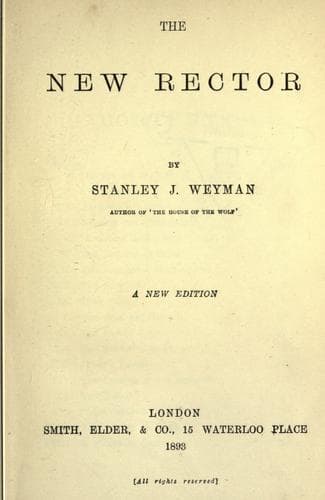
Clergy -- England -- Fiction; England -- Social life and customs -- 19th century -- Fiction
“Well, to be quite candid, I do,” Mr. Bonamy replied curtly. Nor was
this unexpected slap in the face rendered more tolerable by the
qualification he hastened to add—“or getting it stolen.”
The curate started. “This is not to be borne,” he cried hotly. He
looked at the archdeacon as if expecting him to interfere. But he found
that gentleman’s face grave and troubled, and, seeing he must expect no
help from him at present, he continued, “Do you dare to make so serious
an accusation on such evidence as this, Mr. Bonamy?”
“On that,” the lawyer replied, pointing to the paper, “and on other
evidence besides.”
The curate flinched. Had they found Felton, the earl’s servant? Had
they any more scraps of paper—any more self-wrought damning evidence of
that kind? It was only by an effort, which was apparent to one at least
of his hearers, that he gathered himself together, and answered, with a
show of promptitude and ease, “Other evidence? What, I ask? Produce
it!”
“Here it is,” said Mr. Bonamy, pointing to Jack Smith, who had been
standing at his elbow throughout the discussion.
“What has he to do with it?” Clode muttered with dry lips.
“Only this,” the barrister said quietly, addressing himself to the
archdeacon. “That some time ago I saw Mr. Clode replace a packet in the
cupboard in the rector’s library. He only discovered my presence in the
room when the cupboard door was open, and his agitation on observing me
struck me as strange. Afterward I made inquiries of Mr. Lindo, without
telling him my reason, and learned that Mr. Clode had no business at
that cupboard—which was, in fact, devoted to the rector’s private
papers.”
“Perhaps, Mr. Clode, you will explain that,” said the lawyer with quiet
triumph.
He might have denied it had he spoken out at once. He might have given
Jack the lie. But he saw with sudden and horrible clearness how this
thing fitted that other thing, and this evidence corroborated that; and
he lost his presence of mind, and for a moment stood speechless,
glaring at his new accuser. He did not need to look at the archdeacon
to be sure that his face was no longer grave only, but stern and
suspicious. The gas-jets flared before his eyes and dazzled him. The
room seemed to be turning. He could not answer. It was only when he had
stood for an age, as it seemed to him, dumb and self-convicted before
those three faces, that he summoned up courage to mutter, “It is false.
It is all false, I say!” and to stamp his foot on the floor.
But no one answered him, and he quailed. His nerves were shaken. He,
who on ordinary occasions prided himself on his tact and management,
dared not now urge another word in his own defence lest some new piece
of evidence should arise to give him the lie. The meaning silence of
his accusers and his own conscience were too much for him. And,
suddenly snatching up his hat, which lay on a chair beside him, he
rushed from the room.
Public-domain text, read in full here on John Shaqi.
Reviews
Reviews
No reviews yet
Be the first to share your thoughts on this work.
Elsewhere in the archive
Join the Discussion
Join the discussion
Sign in to leave a comment or review.
Sign InorCreate an account