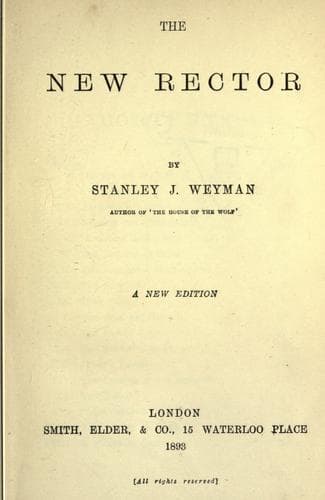
Clergy -- England -- Fiction; England -- Social life and customs -- 19th century -- Fiction
She had much more to say—or, rather, had she said all that was in her
mind she would have had. But his tone helped her to recover
herself—helped her to play the part on which she had long ago decided.
In her way she loved this man, and her will had melted at sight of him,
standing downcast and defeated before her. Had he attacked her on the
side of her affections he might have done much—he might have prevailed.
But his hard words recalled her to her natural self. “What would you
have me say?” she answered, looking steadily across the table at him.
Something, she began to see, had happened besides the loss of the
living—something which had hurt him sorely. And as she discerned this,
she compared his dishevelled, untidy dress with the luxury of the room,
and shivered at the thought of the precipice on the brink of which she
had paused.
He did not answer.
“What would you have me say?” she repeated more firmly.
“If you do not know, I cannot teach you,” he retorted, with a sneer.
“You have no right to say that,” she replied bravely. “You remember our
compact.”
“You intend to keep to it?” he answered scornfully.
She had no doubt about that now, and she summoned up her courage by an
effort. “Certainly I do,” she murmured. “I thought you understood me. I
tried to make my meaning clear.”
Clode did not answer her at once. He stood looking at her, his eyes
glowing. He knew that his only hope, if hope there might be, lay in
gaining some word from her now—now, before any rumor to his
disadvantage should get abroad in the town. But his temper, long
restrained, was so infuriated by disappointment and defeat, that for
the moment love did not prevail with him. He knew that a tender word
might do much, but he could not frame it. When he did at last find
tongue it was only to say, “And that is your final decision?”
“It is,” she answered in a low voice. She did not dare to look up at
him.
“And all you have to say to me?”
“Yes. Except that I wish you well. I shall always wish you well, Mr.
Clode,” she muttered.
“Thank you,” he answered coldly.
So coldly, and with so much composure, that she did not guess the gust
of hatred of all things and all men which was in his heart. He was
beside himself with love, rage, disappointment. For a moment longer he
stood gazing at her downcast face. But she did not look up at him; and
presently, in a strange silence, he turned and went out of the room.
CHAPTER XXV.
HUMBLE PIE.
The success of reticence is great. Mr. Bonamy and his nephew, as they
went home to tea after their victory, plumed themselves not a little
upon the proof of this which they had just given Mr. Clode. They said
little, it is true; even to one another, but more than once Mr. Bonamy
chuckled in a particularly dry manner, and at the top of the street
Jack made an observation “You think the archdeacon was satisfied?” he
asked, turning to his companion for a moment.
Public-domain text, read in full here on John Shaqi.
Reviews
Reviews
No reviews yet
Be the first to share your thoughts on this work.
Elsewhere in the archive
Join the Discussion
Join the discussion
Sign in to leave a comment or review.
Sign InorCreate an account