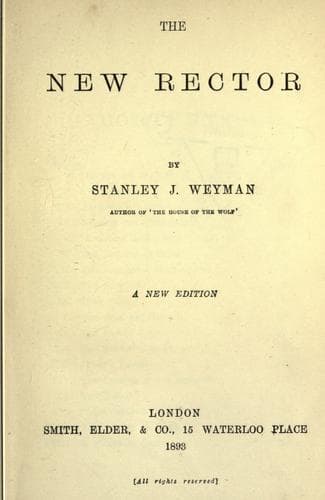
Clergy -- England -- Fiction; England -- Social life and customs -- 19th century -- Fiction
He had not gone fifty yards along the pavement before he recognized the
mad folly of this retreat—the utter surrender of all his hopes and
ambitions which it meant. But it was too late. The strong man had met a
stronger. His very triumph and victory had gone some way toward undoing
him, by rendering him more open to surprise and less prepared for
sudden attack. Now it was too late to do more than repent. He saw that.
Hurrying through the darkness, heedless whither he went, he invented a
dozen stories to explain his conduct. But always the archdeacon’s grave
face rose before him, and he rejected the clever fictions and the
sophisms in support of them, which his ingenuity was now so quick to
suggest.
How he cursed the madness, the insensate folly, which had wrecked him!
Had he only let matters take their own course and stood aside, he would
have gained his ends! For a minute and a half he had been as good as
rector of Claversham. And now!
Laura Hammond, crossing the hall after tea, heard the outer door open
behind her, and, feeling the cold gust of air which entered, stopped
and turned, and saw him standing on the mat. He had let himself in in
this way on more than one occasion before, and it was not that which in
a moment caused her heart to sink. She had been expecting him all day,
for she knew the crisis was imminent, and had been hourly looking for
news. But she had not been expecting him in this guise. There was a
strange disorder in his air and manner. He was wet and splashed with
mud. He held his hat in his hand, as if he had been walking bareheaded
in the rain. His eyes shone with a wild light, and he looked at her
oddly. She turned and went toward him. “Is it you?” she said timidly.
“Oh, yes, it is I,” he answered, with a forced laugh. “I want to speak
to you.” And he let drop the _portière_, which he had hitherto held in
his hand.
There was a light in the breakfast-room, which opened on the hall, and
she led the way into that room. He followed her and closed the door
behind him. She pointed to a chair, but he did not take it. “What is
it?” she said, looking up at him in real alarm. “What is the matter,
Stephen?”
“Everything!” he answered, with another laugh. “I am leaving
Claversham.”
“You are leaving?” she said incredulously.
“Yes, leaving!” he answered.
“To-night?” she stammered.
“Well, not to-night,” he answered, with rude irony. “To-morrow. I have
been within an ace of getting the living, and I—I have lost it. That is
all.”
Her cheek turned a shade paler, and she laid one hand on the table to
steady herself. “I am so sorry,” she murmured.
He did not see her tremor; he heard only her words, and he resented
them bitterly. “Have you nothing more to say than that?” he cried.
Public-domain text, read in full here on John Shaqi.
Reviews
Reviews
No reviews yet
Be the first to share your thoughts on this work.
Elsewhere in the archive
Join the Discussion
Join the discussion
Sign in to leave a comment or review.
Sign InorCreate an account