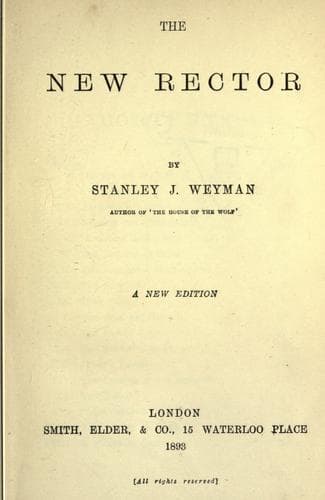
Clergy -- England -- Fiction; England -- Social life and customs -- 19th century -- Fiction
It was quite true. She knew him better now. A fellow-feeling makes us
wondrous kind. Love, which blinds our eyes to some things, opens them
to others. Had Jack offered Kate “Their Wedding Journey” now she might
still have asked him to change the book for another, but assuredly she
would not have told him it sounded silly, nor hurt his feelings by so
much as a look.
It was quite true that she thought him all she said, that her eyes grew
moist for his sake. But his was the minute only; the hour was
another’s. Daintry, proceeding to speculate gloomily on the dulness of
Claversham without Jack, thought her sister was attending to her,
whereas Kate’s thoughts were far away now, centred on a fair head and a
bright boyish face, and a solitary room in which she pictured Reginald
Lindo sitting alone and despondent, the short-lived brilliance of his
Claversham career already extinguished. What were his thoughts, she
wondered. Was he regretting—for the strongest have their hours of
weakness—the step he had taken? Was he blaming her for the advice she
had given? Was he giving a thought to her at all, or only planning the
new life on which he must now enter—forming the new hopes which must
henceforth cheer him on?
Kate let her work drop and looked dreamily before her. Assuredly the
prospect was a dull and uninviting one. Before _his_ coming there had
always been the unknown something, which a girl’s future holds—a
possibility of change, of living a happier, fuller life. But now she
had nothing of this kind before her. He had come and robbed her even of
this, and given her in return only regret and humiliation, and a few—a
very few—hours of strange pleasure and sunshine and womanly pride in a
woman’s influence nobly used. Yet would she have had it otherwise? No,
not for all the unknown possibilities of change, not though Claversham
life should stretch its dulness unbroken through a century.
She was sitting alone in the dining-room next morning, Mr. Bonamy being
at the office, and Daintry out shopping, when the maid came in and
announced that Mr. Lindo was at the door and wished to see her. “Are
you sure that he did not ask for Mr. Bonamy?” Kate said, rising and
laying down her work with outward composure and secret agitation.
“No; he asked particularly for you, miss,” the servant answered,
standing with her hand on the door.
“Very well; you can show him in here,” Kate replied, casting an eye
round her, but disdaining to remove the signs of domestic employment
which met its scrutiny. “He has come to say good-by,” she thought to
herself; and she schooled herself to play her part fitly and close the
little drama with decency and reserve.
He came in looking very thoughtful. She need not have feared for her
father’s papers, her sister’s dog’s-eared Ollendorf, or her own sewing.
He did not so much as glance at them. She thought she saw business in
his eye, and she said as he advanced, “Did you wish to see me or my
father, Mr. Lindo?”
Public-domain text, read in full here on John Shaqi.
Reviews
Reviews
No reviews yet
Be the first to share your thoughts on this work.
Elsewhere in the archive
Join the Discussion
Join the discussion
Sign in to leave a comment or review.
Sign InorCreate an account