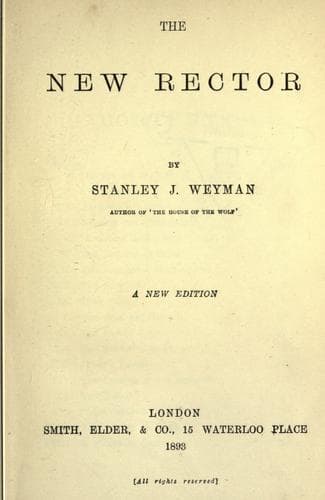
Clergy -- England -- Fiction; England -- Social life and customs -- 19th century -- Fiction
“You, Miss Bonamy,” he answered, shaking hands with her. “You have
heard the news, I suppose?”
“Yes,” she replied soberly. “I am so very sorry. I fear—I mean I regret
now, that when you——”
“Asked for advice”—he continued, helping her out with a grave smile. He
had taken the great leather-covered easy-chair on the other side of the
fireplace, and was sitting forward in it, toying with his hat.
“Yes,” she said, coloring—“if you like to put it in that very
flattering form—I regret now that I presumed to give it, Mr. Lindo.”
“I am sorry for that,” he answered, looking up at her as he spoke.
She felt herself coloring anew. “Why?” she asked rather tremulously.
“Because I have come to ask your advice again. You will not refuse to
give it me?”
She looked at him in surprise; with a little annoyance even. It was
absurd. Why should he come to her in this way? Why, because on one
occasion, when circumstances had impelled him to speak and her to
answer, she had presumed to advise—why should he again come to her of
set purpose? It was ridiculous of him. “I think I must refuse,” she
said gravely and a little formally. “I know nothing of business.”
“It is not upon a matter of business,” he answered.
She uttered a sigh of impatience. “I think you are very foolish, Mr.
Lindo. Why do you not go to my father?”
“Well, because it is—because it is on a rather delicate matter,” he
answered impulsively.
“Still I do not see why you should bring it to me,” she objected, with
a flash in her gray eyes, and many memories in her mind.
“Well, I will tell you why I bring it to you,” he answered bluntly.
“Because I acted on your advice the other day; and that, you see, Miss
Bonamy, has put me in this fix; and—and, in fact, made other advice
necessary, don’t you see?”
“I see you are inclined to be somewhat ungenerous,” she answered. “But
if it must be so, pray go on.”
He rose slowly and stood leaning against the mantel-shelf in his
favorite attitude, his foot on the fender. “I will be as short as I
can,” he said, a nervousness she did not fail to note in his manner.
“Perhaps you will kindly hear me to the end before you solve my problem
for me. It will help me a little, I think, if I may put my case in the
third person. Miss Bonamy”—he paused on the name and cleared his
throat, and then went on more quickly—“a man I know, young and keen,
and at the time successful—successful beyond his hopes, so that others
of his age and standing looked on him with envy, came one day to know a
girl, and, from the moment of knowing her, to admire and esteem her.
She was not only very beautiful, but he thought he saw in her, almost
from the first hour of their acquaintance, such noble and generous
qualities as all men, even the weakest, would fain imagine in the woman
they love.”
Kate moved suddenly in her chair as if to rise. Then she sat back
again, and he went on.
Public-domain text, read in full here on John Shaqi.
Reviews
Reviews
No reviews yet
Be the first to share your thoughts on this work.
Elsewhere in the archive
Join the Discussion
Join the discussion
Sign in to leave a comment or review.
Sign InorCreate an account