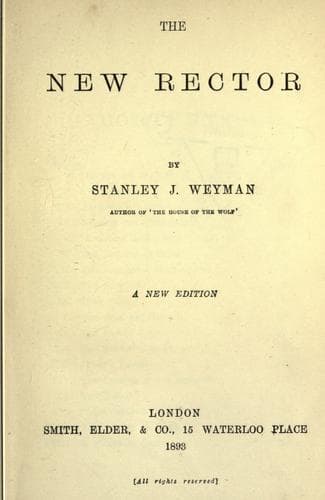
Clergy -- England -- Fiction; England -- Social life and customs -- 19th century -- Fiction
“This was a weak man,” he said in a low voice. “He had had small
experience; let that be some excuse for him. He entered at this time on
a new field of work in which he found himself of importance and fancied
himself of greater importance. There he had frequent opportunities of
meeting the woman I have mentioned, who had already made an impression
on him. But his head was turned. He discovered that for certain small
and unworthy reasons her goodness and her fairness were not recognized
by those among whom he mixed, and he had the meanness to swim with the
current and to strive to think no more of the woman to whom his heart
had gone out. He acted like a cur, in fact, and presently he had his
reward. Evil times came upon him. The position he loved was threatened.
Finally he lost it, and found himself again where he had started in
life—a poor curate without influence or brilliant prospects. Then—it
seems an ignoble, a mean, and a miserable thing to say—he found out for
certain that he loved this woman, and could imagine no greater honor or
happiness than to have her for his wife.”
He paused a moment, and stole a glance at her. Kate sat motionless and
still, her lips compressed and her eyes hidden by their long lashes,
her gaze fixed apparently on the fire. Save that her face was slightly
flushed, and that she breathed quickly, he might have fancied that she
did not understand, or even that she had not heard. When he spoke
again, after waiting anxiously and vainly for any sign, his voice was
husky and agitated. “Will you tell me, Miss Bonamy, what he should do?”
he said. “Should he ask her to forgive him and to trust him, or should
he go away and be silent?”
She did not speak.
“Kate, will you not tell me? Can I not hope to be forgiven?” He was
stooping beside her now, and his hand almost touched her hair.
Then, at last, she looked up at him. “Will not my advice come a little
late?” she whispered tremulously and yet with a smile—a smile which was
at once bright and tearful and eloquent beyond words.
Afterward she thought of a dozen things she should have said to
him—about his certainty of himself, about her father; but at the time
none of these occurred to her. If he had come to her with his hands
full, it would certainly have been otherwise. But she saw him poor
through his own act, and her pride left her. When he took her in his
arms and kissed her, she said not a word. And he said only, “My
darling!”
* * * * *
Public-domain text, read in full here on John Shaqi.
Reviews
Reviews
No reviews yet
Be the first to share your thoughts on this work.
Elsewhere in the archive
Join the Discussion
Join the discussion
Sign in to leave a comment or review.
Sign InorCreate an account