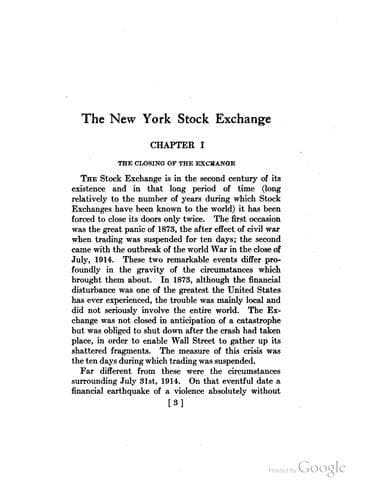
The New York Stock Exchange in the Crisis of 1914Noble, Henry George Stebbins
History
The New York Stock Exchange in the Crisis of 1914
Noble, Henry George Stebbins
New York Stock Exchange
With the above came a letter from a correspondent whose thoughts
carried him back to the old days of buyers' and sellers' options, when
most of the security business was done on 30 or 60 day contracts. He
proposed that the Exchange be reopened so that "all trades made be
'buyer 60'. No other bids or offers to be valid." This would postpone
for two months the settling day for the expected liquidation, and he
felt certain that by that time there could be no trouble in meeting
obligations. Unfortunately at the time he wrote there was no way of
obtaining assurance of this happy outcome. The same idea in a somewhat
different form came from another correspondent who, instead of
deferring payment by a buyer's option, proposed that stocks and bonds
be sold on a 10 per cent. basis "That is, the seller of 100 shares of
Union Pacific at 112 will deliver to buyer 10 per cent. of amount
sold, and receive a check for $1,120, together with a contract in
which the buyer agrees to take 10 per cent. more, or say 10 shares at
the end of six months, 10 shares in 9 months, 10 shares in 12 months,
10 shares in 15 months," etc., etc., at the original price of $112 per
share. This plan seemed to contemplate a bequest of unsettled
contracts to future generations of unsuspecting brokers. The author of
it was particularly solicitous that, in the event of its adoption, his
name should be handed down to posterity along with the unfulfilled
contracts.
An idea of very wide prevalence, which was touched upon in nearly all
communications to the Committee and which even some bankers approved,
was that a preliminary step to reopening should be an agreement by
the banks not to call loans made prior to July 31st, 1914, for some
specified period of time. This idea was very thoroughly discussed and
looked into by the Committee. It was found to present great practical
difficulties, but was never definitely abandoned until the resumption
of business was shown to be possible without it.
* * * * *
Public-domain text, read in full here on John Shaqi.
Reviews
Reviews
No reviews yet
Be the first to share your thoughts on this work.
Join the Discussion
Join the discussion
Sign in to leave a comment or review.
Sign InorCreate an account