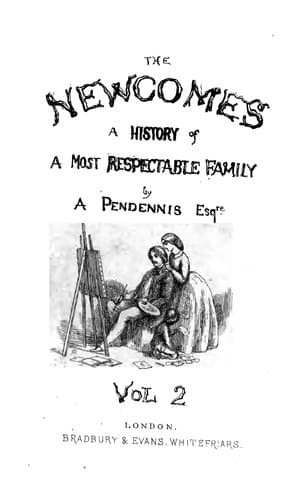
The Newcomes: Memoirs of a Most Respectable FamilyThackeray, William Makepeace
General
The Newcomes: Memoirs of a Most Respectable Family
Thackeray, William Makepeace
Domestic fiction; Families -- England -- Fiction
“Like her! the dear little old woman. I feel as if she had been my
friend all my life! I feel quite drawn towards her. What a wonderful
coincidence that Dr. Goodenough should direct us to this very house! I
have written to your father about it. And to think that I should have
written to Clive at this very house, and quite forgotten Mrs.
Honeyman’s name—and such an odd name too. I forget everything,
everything! You know I forgot your Aunt Louisa’s husband’s name; and
when I was godmother to her baby, and the clergyman said, ‘What is the
infant’s name?’ I said, ‘Really I forget.’ And so I did. He was a
London clergyman, but I forget at what church. Suppose it should be
this very Mr. Honeyman! It may have been, you know, and then the
coincidence would be still more droll. That tall, old, nice-looking,
respectable person, with a mark on her nose, the housekeeper—what is
her name?—seems a most invaluable person. I think I shall ask her to
come to us. I am sure she would save me I don’t know how much money
every week; and I am certain Mrs. Trotter is making a fortune by us. I
shall write to your papa, and ask him permission to ask this person.”
Ethel’s mother was constantly falling in love with her new
acquaintances; their man-servants and their maid-servants, their horses
and ponies, and the visitor within their gates. She would ask strangers
to Newcome, hug and embrace them on Sunday; not speak to them on
Monday; and on Tuesday behave so rudely to them, that they were gone
before Wednesday. Her daughter had had so many governesses—all darlings
during the first week, and monsters afterwards—that the poor child
possessed none of the accomplishments of her age. She could not play on
the piano; she could not speak French well; she could not tell you when
gunpowder was invented: she had not the faintest idea of the date of
the Norman Conquest, or whether the earth went round the sun, or vice
versa. She did not know the number of counties in England, Scotland,
and Wales, let alone Ireland; she did not know the difference between
latitude and longitude. She had had so many governesses: their accounts
differed: poor Ethel was bewildered by a multiplicity of teachers, and
thought herself a monster of ignorance. They gave her a book at a
Sunday School, and little girls of eight years old answered questions
of which she knew nothing. The place swam before her. She could not see
the sun shining on their fair flaxen heads and pretty faces. The rosy
little children holding up their eager hands, and crying the answer to
this question and that, seemed mocking her. She seemed to read in the
book, “O Ethel, you dunce, dunce, dunce!” She went home silent in the
carriage, and burst into bitter tears on her bed. Naturally a haughty
girl of the highest spirit, resolute and imperious, this little visit
to the parish school taught Ethel lessons more valuable than ever so
much arithmetic and geography. Clive has told me a story of her in her
Public-domain text, read in full here on John Shaqi.
Reviews
Reviews
No reviews yet
Be the first to share your thoughts on this work.
Elsewhere in the archive
Join the Discussion
Join the discussion
Sign in to leave a comment or review.
Sign InorCreate an account