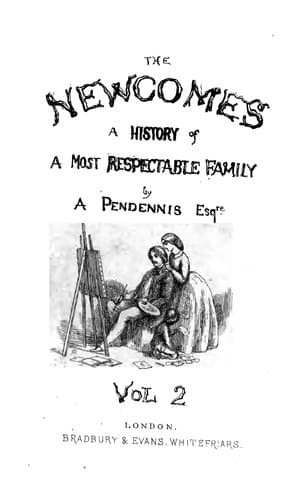
The Newcomes: Memoirs of a Most Respectable FamilyThackeray, William Makepeace
General
The Newcomes: Memoirs of a Most Respectable Family
Thackeray, William Makepeace
Domestic fiction; Families -- England -- Fiction
“We ought to be ashamed of doing wrong. We must go and ask his pardon.
Once when I was a young man in India,” the father continued very
gravely, “some hot words passed at mess—not such an insult as that of
last night; I don’t think I could have quite borne that—and people
found fault with me for forgiving the youngster who had uttered the
offensive expressions over his wine. Some of my acquaintance sneered at
my courage, and that is a hard imputation for a young fellow of spirit
to bear. But providentially, you see, it was war-time, and very soon
after I had the good luck to show that I was not a _poule mouillée_, as
the French call it; and the man who insulted me, and whom I forgave,
became my fastest friend, and died by my side—it was poor Jack
Cutler—at Argaum. We must go and ask Barnes Newcome’s pardon, sir, and
forgive other people’s trespasses, my boy, if we hope forgiveness of
our own.” His voice sank down as he spoke, and he bowed his honest head
reverently. I have heard his son tell the simple story years
afterwards, with tears in his eyes.
Piccadilly was hardly yet awake the next morning, and the sparkling
dews and the poor homeless vagabonds still had possession of the grass
of Hyde Park, as the pair walked up to Sir Brian Newcome’s house, where
the shutters were just opening to let in the day. The housemaid, who
was scrubbing the steps of the house, and washing its trim feet in a
manner which became such a polite mansion’s morning toilet, knew Master
Clive, and smiled at him from under her blousy curl-papers, admitting
the two gentlemen into Sir Brian’s dining-room, where they proposed to
wait until Mr. Barnes should appear. There they sate for an hour
looking at Lawrence’s picture of Lady Anne, leaning over a harp,
attired in white muslin; at Harlowe’s portrait of Mrs. Newcome, with
her two sons simpering at her knees, painted at a time when the Newcome
Brothers were not the bald-headed, red-whiskered British merchants with
whom the reader has made acquaintance, but chubby children with hair
flowing down their backs, and quaint little swallow-tailed jackets and
nankeen trousers. A splendid portrait of the late Earl of Kew in his
peer’s robes hangs opposite his daughter and her harp. We are writing
of George the Fourth’s reign; I dare say there hung in the room a fine
framed print of that great sovereign. The chandelier is in a canvas
bag; the vast sideboard, whereon are erected open frames for the
support of Sir Brian Newcome’s grand silver trays, which on dinner days
gleam on that festive board, now groans under the weight of Sir Brian’s
bluebooks. An immense receptacle for wine, shaped like a Roman
sarcophagus, lurks under the sideboard. Two people sitting at that
large dining-table must talk very loud so as to make themselves heard
across those great slabs of mahogany covered with damask. The butler
and servants who attend at the table take a long time walking round it.
Public-domain text, read in full here on John Shaqi.
Reviews
Reviews
No reviews yet
Be the first to share your thoughts on this work.
Elsewhere in the archive
Join the Discussion
Join the discussion
Sign in to leave a comment or review.
Sign InorCreate an account