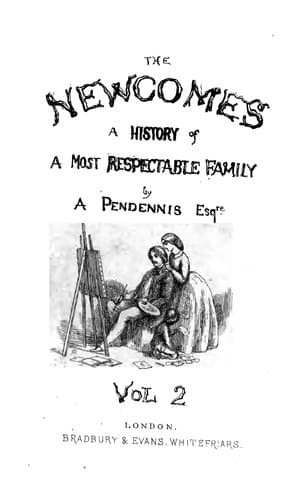
The Newcomes: Memoirs of a Most Respectable FamilyThackeray, William Makepeace
General
The Newcomes: Memoirs of a Most Respectable Family
Thackeray, William Makepeace
Domestic fiction; Families -- England -- Fiction
He took a little slim white hand and laid it down on his brown palm,
where it looked all the whiter: he cleared the grizzled mustachio from
his mouth, and stooping down he kissed the little white hand with a
great deal of grace and dignity. There was no point of resemblance, and
yet a something in the girl’s look, voice, and movements, which caused
his heart to thrill, and an image out of the past to rise up and salute
him. The eyes which had brightened his youth (and which he saw in his
dreams and thoughts for faithful years afterwards, as though they
looked at him out of heaven) seemed to shine upon him after
five-and-thirty years. He remembered such a fair bending neck and
clustering hair, such a light foot and airy figure, such a slim hand
lying in his own—and now parted from it with a gap of ten thousand long
days between. It is an old saying, that we forget nothing; as people in
fever begin suddenly to talk the language of their infancy we are
stricken by memory sometimes, and old affections rush back on us as
vivid as in the time when they were our daily talk, when their presence
gladdened our eyes, when their accents thrilled in our ears, when with
passionate tears and grief we flung ourselves upon their hopeless
corpses. Parting is death, at least as far as life is concerned. A
passion comes to an end; it is carried off in a coffin, or weeping in a
post-chaise; it drops out of life one way or other, and the earthclods
close over it, and we see it no more. But it has been part of our
souls, and it is eternal. Does a mother not love her dead infant? a man
his lost mistress? with the fond wife nestling at his side,—yes, with
twenty children smiling round her knee. No doubt, as the old soldier
held the girl’s hand in his, the little talisman led him back to Hades,
and he saw Leonora.——
“How do you do, uncle?” say girls Nos. 2 and 3 in a pretty little
infantile chorus. He drops the talisman, he is back in common life
again—the dancing baby in the arms of the bobbing nurse babbles a
welcome. Alfred looks up for a while at his uncle in the white
trousers, and then instantly proposes that Clive should make him some
drawings; and is on his knees at the next moment. He is always climbing
on somebody or something, or winding over chairs, curling through
banisters, standing on somebody’s head, or his own head,—as his
convalescence advances, his breakages are fearful. Miss Honeyman and
Hannah will talk about his dilapidations for years after the little
chap has left them. When he is a jolly young officer in the Guards, and
comes to see them at Brighton, they will show him the blue-dragon
Chayny jar, on which he would sit, and which he cried so fearfully upon
breaking.
Public-domain text, read in full here on John Shaqi.
Reviews
Reviews
No reviews yet
Be the first to share your thoughts on this work.
Elsewhere in the archive
Join the Discussion
Join the discussion
Sign in to leave a comment or review.
Sign InorCreate an account